Architecture & Execution
Rokz architecture is organized around a deterministic transaction lifecycle:
The purpose of this architecture is not to create another interoperability network. It is to create a unified execution fabric across heterogeneous blockchain environments.
Rokz does not connect chains for communication alone. It coordinates execution conditions across chains so that transactions can process against verified state.
Architectural Layers
The Rokz architecture can be understood as five coordinated layers:
State Verification Layer.
State Verification Layer;
Each layer removes a specific failure mode from current DeFi execution.
Function and Failure Mode Removed
Converts user action into deterministic intent, removing user exposure to fragmented infrastructure.
Validates execution conditions before processing, removing blind transaction submission.
Normalizes heterogeneous state across networks, removing isolated state dependency.
Triggers native local execution, removing routed and bridged execution logic.
Finalizes coordinated outcomes, removing probabilistic finality.
Function and Failure Mode Removed
Converts user action into deterministic intent, removing user exposure to fragmented infrastructure.
Validates execution conditions before processing, removing blind transaction submission.
Normalizes heterogeneous state across networks, removing isolated state dependency.
Triggers native local execution, removing routed and bridged execution logic.
Finalizes coordinated outcomes, removing probabilistic finality.
Together, these layers transform transaction processing from path-dependent execution into state-verified coordination.
Each Rokz layer removes a specific execution failure: fragmentation, blind submission, isolated state, routed logic, or probabilistic settlement.
Intent Layer
The Intent Layer converts user action into a unified deterministic intent.
In current DeFi, the user often signs into infrastructure complexity. Even when the interface is simplified, the underlying transaction still depends on:
Rokz abstracts those conditions into a deterministic intent.
The user action is normalized into:
target asset or destination condition;
acceptable execution constraints;
destination network conditions;
transaction-specific parameters.
target asset or destination condition;
acceptable execution constraints;
destination network conditions;
transaction-specific parameters.
The user signs intent, not fragmented infrastructure complexity.
No routing path is exposed to the user as the operating primitive. Rokz does not ask the user to select bridge paths, intermediate hops, liquidity venues, or routing logic. Those elements are replaced by state verification and deterministic triggering through Rokz Clients.
A simplified interface does not solve execution fragmentation if the transaction still depends on bridges, routes, public mempools, and probabilistic state underneath.
State Verification Layer
The State Verification Layer determines whether execution should occur.
Rokz Clients retrieve real-time state across relevant chains and validate whether the transaction can be executed under deterministic conditions.
local mempool or execution conditions;
local mempool or execution conditions;
A transaction is not processed because a path has been discovered. It is processed only if the verified state supports execution.
This is the primary distinction between Rokz and path-based systems. Traditional infrastructure constructs a route and then submits execution into an environment where conditions may change. Rokz verifies conditions first and triggers execution only after deterministic readiness is established.
Rokz begins with verified state. Traditional systems begin with transaction submission and attempt to manage state drift afterward.
Synchronization Layer
The Synchronization Layer converts heterogeneous chain states into one verified coordination layer.
Different networks do not share the same:
Networks do not share the same:
transaction ordering systems;
transaction ordering systems;
This is why conventional interoperability remains incomplete.
Message passing does not
synchronize state.
Bridge movement does not align
execution conditions.
Routing does not create a common
settlement basis.
Message passing does not synchronize state.
Bridge movement does not align execution conditions.
Routing does not create a common settlement basis.
Rokz Clients normalize heterogeneous state into a synchronized state layer that the protocol can use for deterministic coordination.
The purpose is not to erase chain-specific differences. The purpose is to make those differences operationally abstracted at the execution layer.
Rokz does not require every chain to become technically identical. It abstracts differences by synchronizing and verifying the state required for execution.
Execution Layer
The Execution Layer triggers native transaction processing only when verified state exists.
Execution is performed inside native local liquidity environments. Rokz Clients interact directly with local smart contracts, rather than relying on bridge custody, wrapped asset movement, or intermediary routing.
This layer is responsible for:
native smart-contract calls;
local liquidity execution;
direct transaction submission;
private execution handling;
state-triggered processing;
coordination with other Rokz Clients
when cross-network settlement is
required.
native smart-contract calls;
local liquidity execution;
direct transaction submission;
private execution handling;
state-triggered processing;
coordination with other Rokz Clients when cross-network settlement is required.
There is no public route exposure as the primary execution model. There is no bridge-based custody dependency. There is no external solver market controlling the outcome.
Execution becomes a direct interaction between verified state and local liquidity.
Rokz execution is triggered against native liquidity after state verification, not routed through external paths or bridge-dependent movement.
Settlement Layer
The Settlement Layer finalizes outcomes across relevant networks.
Settlement in Rokz is synchronized rather than probabilistic. The user receives the final result while execution complexity remains abstracted underneath.
The objective is not simply to complete a transaction. The objective is to confirm that the full coordinated outcome has been reached under verified conditions.
Atomic coordination is central to this layer. If the required execution conditions cannot finalize successfully, the transaction should not expose the user to incomplete cross-network state.
The settlement architecture is designed to prevent:
Settlement architecture prevents:
broken transaction outcomes;
unresolved cross-network state;
incomplete user settlement;
broken transaction outcomes;
unresolved cross-network state;
incomplete user settlement;
A transaction outcome cannot be institutionally reliable if execution finalizes unevenly across networks without coordinated settlement guarantees.
Deterministic Execution Lifecycle
The Rokz execution lifecycle follows a state-verified sequence.
1 — User Creates Intent
The user initiates a transaction objective, transformed into deterministic intent with asset parameters, destination conditions, execution constraints, and required outcomes.
2 — Rokz Clients Receive Intent Privately
The intent enters private Rokz Client intake, preventing transaction direction, size, timing, and structure from becoming publicly visible before execution conditions are secured.
2 — Clients Receive Intent Privately
The intent enters private Rokz Client intake, preventing transaction direction, size, timing, and structure from becoming publicly visible before execution conditions are secured.
3 — Clients Retrieve State Across Relevant Chains
Rokz Clients retrieve liquidity depth, token availability, pool conditions, price state, finality assumptions, and network-specific execution constraints.
3 — Clients Retrieve State
Rokz Clients retrieve liquidity depth, token availability, pool conditions, price state, finality assumptions, and network-specific execution constraints.
4 — Liquidity and Price Conditions Are Verified
Rokz verifies whether required liquidity exists and whether price conditions remain within acceptable execution constraints.
4 — Liquidity & Pricing Verified
Rokz verifies whether required liquidity exists and whether price conditions remain within acceptable execution constraints.
5 — States Are Normalized Into a Verified Snapshot
Heterogeneous observations are normalized into a unified deterministic snapshot that determines whether execution can proceed.
5 — States Unified Into Snapshot
Heterogeneous observations are normalized into a unified deterministic snapshot that determines whether execution can proceed.
6 — Execution Conditions Are Validated
If conditions are invalid, the transaction does not blindly enter execution. It can be rejected, recalculated, or re-verified.
6 — Execution Conditions Validated
If conditions are invalid, the transaction does not blindly enter execution. It can be rejected, recalculated, or re-verified.
7 — MPC Coordinates Secure Signing
MPC distributes signing responsibility and avoids centralized private-key control.
7 — MPC Enables Secure Signing
MPC distributes signing responsibility and avoids centralized private-key control.
8 — Execution Is Triggered Natively
Rokz Clients call local contracts where liquidity already exists, instead of moving liquidity into Rokz or routing through bridge infrastructure.
9 — Settlement Finalizes Atomically
Settlement finalizes only if required execution conditions are satisfied, reducing partial-completion risk.
10 — User Receives Final Result
The user receives the intended result while chain-specific execution complexity remains abstracted by Rokz Protocol.
The Rokz lifecycle begins with private intent and verified state, not route discovery. Execution is permitted only after deterministic readiness is established.
Cross-Chain Execution Without Bridges
Rokz is not bridge-based.
Assets are not transferred through bridge custody. Wrapped assets are not required as the core execution model. Liquidity is not moved into Rokz. Execution is coordinated across native environments.
Rokz synchronizes execution, not liquidity movement.
This matters because bridge-based execution introduces:
additional attack surfaces;
additional attack surfaces;
Even when a bridge is operationally reliable, it still inserts an external transfer layer between intent and outcome. That layer does not create synchronized state. It only moves value or representation.
Bridge-Based Execution vs. Rokz Execution
Moves assets or wrapped representations
Coordinates execution across native liquidity
Introduces transfer delay
Triggers local execution after state verification
Requires bridge custody or bridge logic
Removes bridge dependency from execution logic
Preserves native liquidity environments
Finality remains asynchronous
Settlement is coordinated through verified state
Liquidity movement becomes the primitive
Execution synchronization becomes the primitive
Moves assets or wrapped representations
Coordinates execution across native liquidity
Introduces transfer delay
Triggers local execution after state verification
Requires bridge custody or bridge logic
Removes bridge dependency from execution logic
Preserves native liquidity environments
Finality remains asynchronous
Settlement is coordinated through verified state
Liquidity movement becomes the primitive
Execution synchronization becomes the primitive
This creates six structural advantages:
fewer bridge-custody attack
surfaces;
lower operational overhead;
better execution quality;
no requirement to pre-position
liquidity inside Rokz.
fewer bridge-custody attack surfaces;
lower operational overhead;
better execution quality;
no requirement to pre-position liquidity inside Rokz.
A bridge can move value or representation, but it does not create synchronized state, deterministic finality, or native liquidity coordination.
Rokz does not move the liquidity. Rokz moves the execution logic to where liquidity already exists.
Unified Chain Abstraction Layer
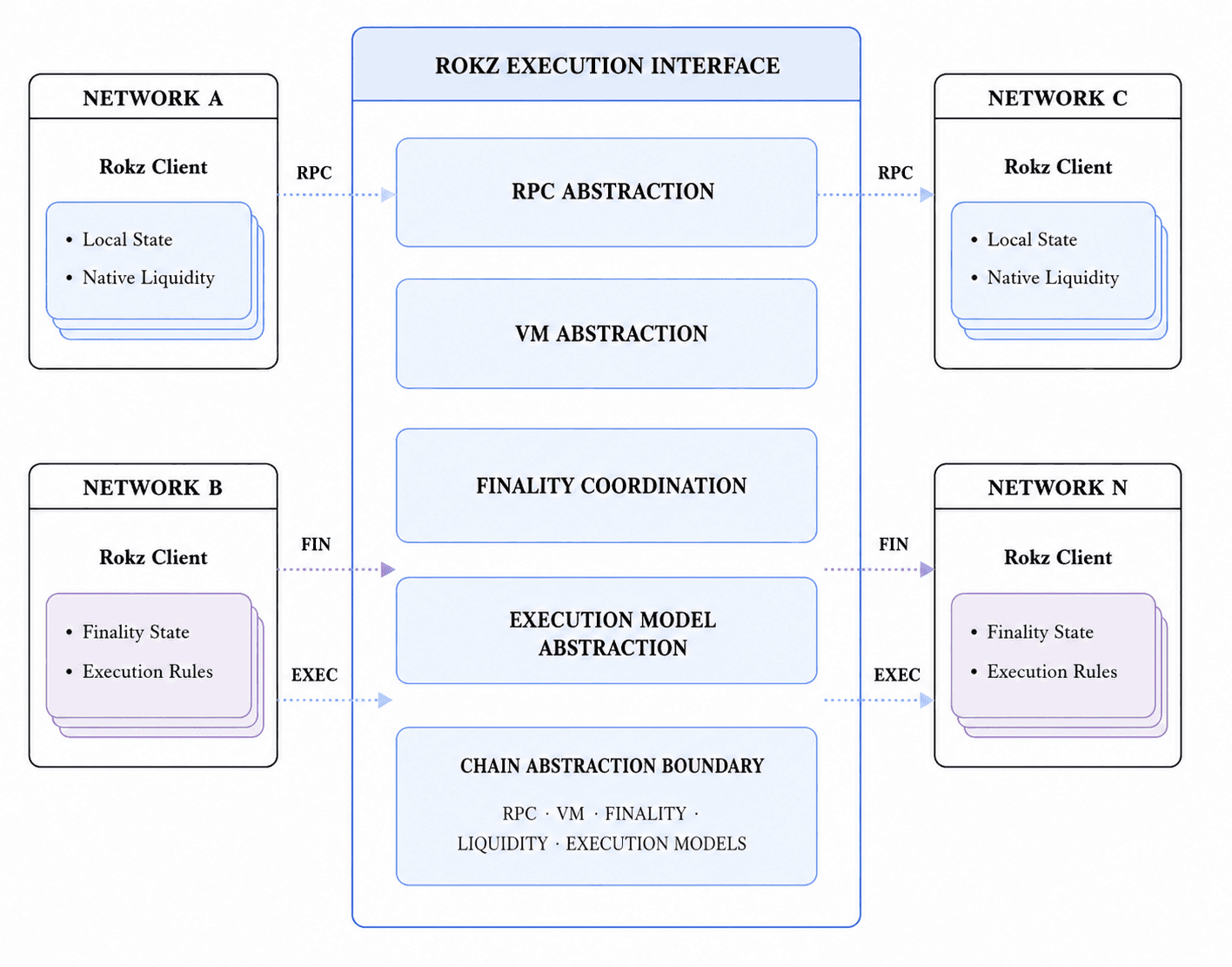
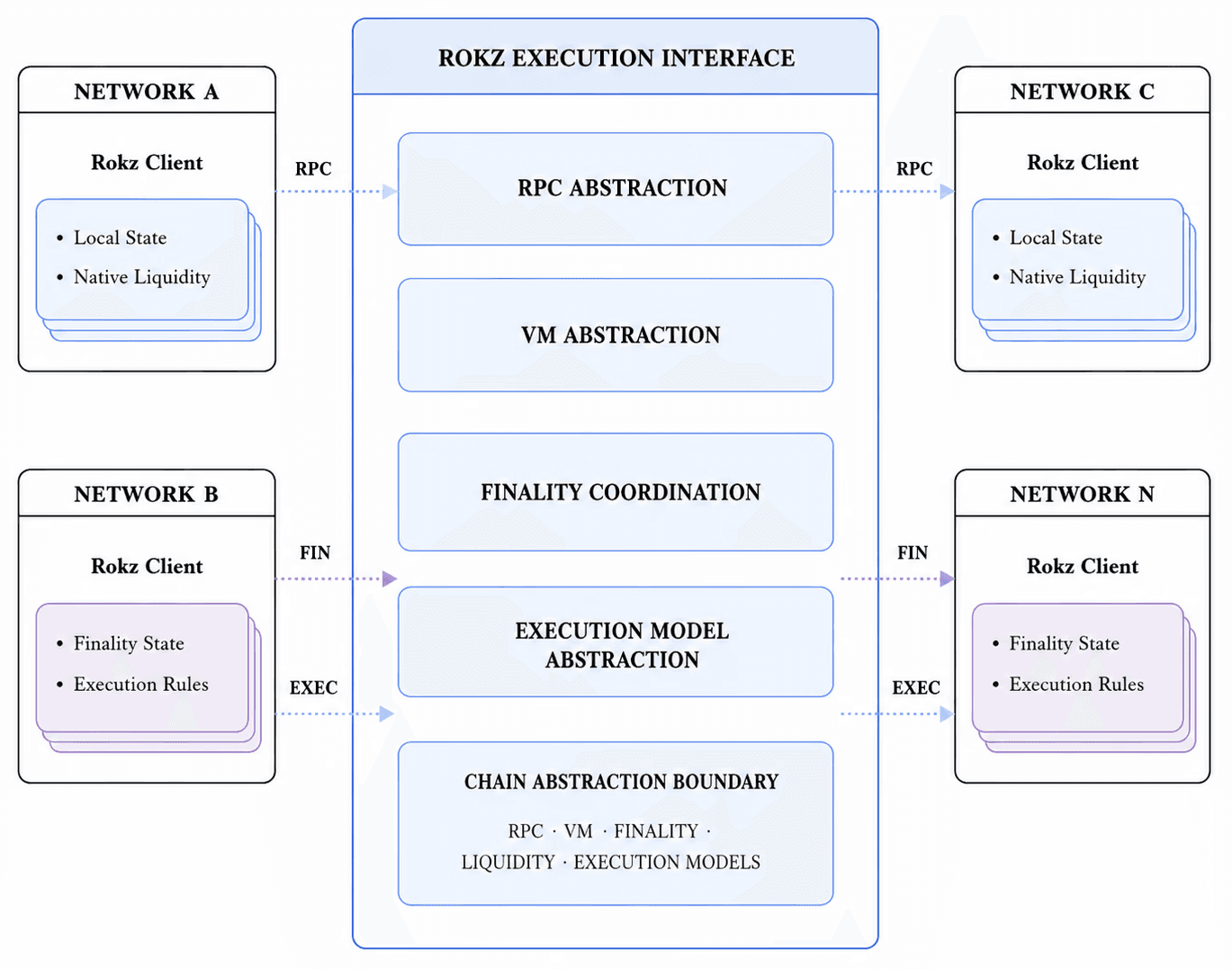
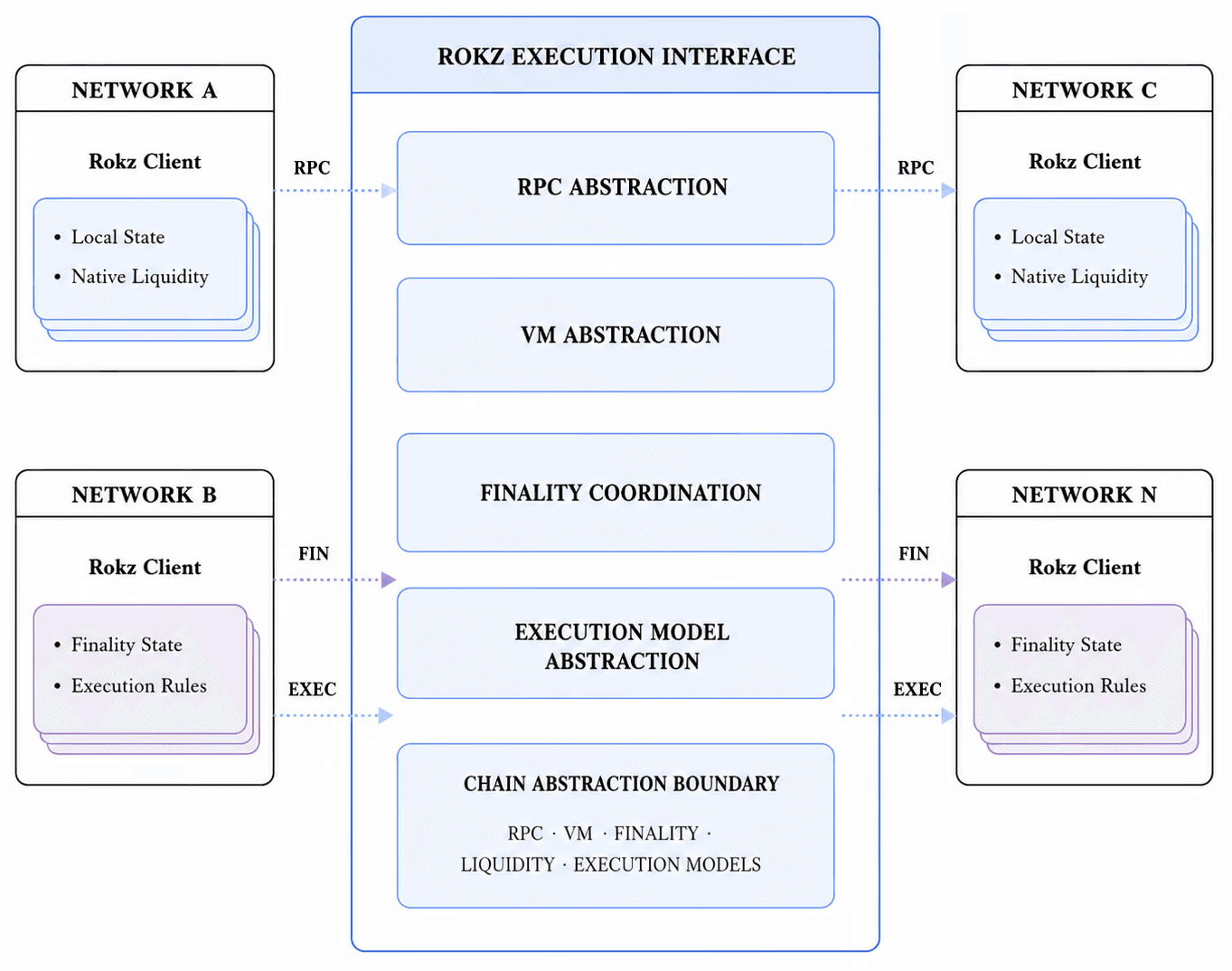
The Unified Chain Abstraction Layer is the infrastructure interface that makes heterogeneous blockchain environments operationally accessible.
This creates six structural advantages:
This creates seven structural advantages:
chain-specific developer complexity.
chain-specific developer complexity.
This abstraction is not a front-end convenience. It is a protocol-level execution interface.
Traditional applications integrate with many chain-specific systems. Each system introduces maintenance cost, dependency risk, operational complexity, and failure modes. Rokz Clients collapse those differences into a universal client interface.
Multiple RPC integrations
Unified execution interface
VM-specific execution logic
Rokz Client normalization
Chain-specific finality assumptions
State-verified finality coordination
Separate liquidity environments
Native local liquidity coordination
Developer integration overhead
Protocol-level execution abstraction
Fragmented operational monitoring
Client-based execution infrastructure
Multiple RPC integrations
Unified execution interface
VM-specific execution logic
Rokz Client normalization
Chain-specific finality assumptions
State-verified finality coordination
Separate liquidity environments
Native local liquidity coordination
Developer integration overhead
Protocol-level execution abstraction
Fragmented operational monitoring
Client-based execution infrastructure
Rokz abstraction is not only about simplifying user experience. It changes the execution model by making heterogeneous blockchain environments operationally accessible through one coordination interface.
Rokz makes heterogeneous blockchain environments operationally accessible through one execution interface.
Execution Quality & Deterministic Guarantees
Execution quality in Rokz is derived from architecture, not post-trade correction.
Current DeFi treats poor execution as an acceptable market condition:
Rokz treats these as symptoms of non-deterministic infrastructure.
Execution Quality Mechanism Map
Execution Failure Surface
Rokz Mechanism and Result
Private execution keeps transaction intent outside public pre-execution visibility, removing the information surface required for adversarial sequencing.
State verification confirms liquidity, price, and execution conditions before native execution, reducing quote-to-execution drift.
Deterministic triggers allow execution to begin only after verified conditions exist, removing blind transaction submission.
Native local execution triggers transactions directly inside native liquidity environments, removing unnecessary routing and bridge dependency.
Atomic settlement ensures settlement completes under coordinated conditions or does not proceed, reducing incomplete cross-network outcomes.
Execution Failure Surface
Rokz Mechanism and Result
Private execution keeps transaction intent outside public pre-execution visibility, removing the information surface required for adversarial sequencing.
State verification confirms liquidity, price, and execution conditions before native execution, reducing quote-to-execution drift.
Deterministic triggers allow execution to begin only after verified conditions exist, removing blind transaction submission.
Native local execution triggers transactions directly inside native liquidity environments, removing unnecessary routing and bridge dependency.
Atomic settlement ensures settlement completes under coordinated conditions or does not proceed, reducing incomplete cross-network outcomes.
Rokz improves execution quality through five mechanisms:
Private execution reduces MEV:
Transaction intent remains outside
public pre-execution visibility,
removing the information surface
required for adversarial sequencing.
Private execution reduces MEV:
State verification reduces slippage:
Liquidity, price, and execution
conditions are verified before native
execution begins, reducing
quote-to-execution drift.
State verification reduces slippage:
Deterministic triggers reduce risk:
Execution is triggered only after
verified conditions exist, rather than
relying on routes that may degrade
during propagation.
Deterministic triggers reduce risk:
Native execution reduces hops:
Transactions execute directly inside
native liquidity environments,
avoiding unnecessary bridge
movement, wrapped representation
logic, or route chains.
Native execution reduces hops
Atomic settlement reduces risk:
Settlement either completes under
coordinated conditions or does not
proceed, reducing exposure to
incomplete cross-network outcomes.
Atomic settlement reduces risk
Private execution reduces MEV exposure: Transaction intent remains outside public pre-execution visibility, removing the information surface required for adversarial sequencing.
Private execution reduces MEV exposure:
State verification reduces slippage: Liquidity, price, and execution conditions are verified before native execution begins, reducing quote-to-execution drift.
State verification reduces slippage:
Deterministic triggers reduce transaction uncertainty: Execution is triggered only after verified conditions exist, rather than relying on routes that may degrade during propagation.
Deterministic triggers reduce transaction uncertainty:
Native local execution reduces unnecessary hops: Transactions execute directly inside native liquidity environments, avoiding unnecessary bridge movement, wrapped representation logic, or route chains.
Native local execution reduces unnecessary hops:
Atomic settlement reduces partial-failure risk: Settlement either completes under coordinated conditions or does not proceed, reducing exposure to incomplete cross-network outcomes.
Atomic settlement reduces partial-failure risk:
Rokz does not merely improve execution after the fact. It changes the conditions under which execution is allowed to begin.
Comparative Execution Analysis
Traditional execution flow is path-dependent. Rokz execution flow is state-dependent.
User intent enters private Rokz Client intake
Transaction enters public mempool
State is verified before execution
Aggregator searches route
Liquidity is checked through Rokz Clients
Bridge or multi-hop path may be used
Execution is triggered after deterministic conditions exist
Liquidity conditions change
Transaction executes natively in local liquidity pools
MEV bots can extract value
No external routing dependency
Settlement finalizes probabilistically
Settlement finalizes atomically
Traditional DEX / Aggregator Flow
User intent enters private Rokz Client intake
Transaction enters public mempool
State is verified before execution
Aggregator searches route
Liquidity is checked through Rokz Clients
Bridge or multi-hop path may be used
Execution is triggered after deterministic conditions exist
Liquidity conditions change
Transaction executes natively in local liquidity pools
MEV bots can extract value
No external routing dependency
Settlement finalizes probabilistically
Settlement finalizes atomically
The analytical difference is not that Rokz finds a better route. The difference is that Rokz removes route dependency as the organizing principle of execution.
Traditional systems begin with transaction submission and then attempt to manage state change. Rokz begins with state verification and only then permits execution.
Traditional systems expose transaction intent before finality. Rokz preserves private execution flow until deterministic conditions are established.
Traditional systems move value or representation across systems. Rokz coordinates local execution where liquidity already exists.
A better route still depends on path construction. Rokz removes the need for path construction by making verified state the execution trigger.