
Whitepaper
v1.4
Whitepaper
v1.4
The Structural Problem
Modern DeFi infrastructure creates the appearance of interoperability while preserving fragmented transaction processing underneath. Applications may connect to multiple chains, aggregators may search across venues, bridges may move asset representations, and solvers may compete to satisfy intents — but none of these mechanisms creates a shared transaction state across heterogeneous blockchain environments.
The Structural Problem
Modern DeFi creates the appearance of interoperability while preserving fragmented execution. Applications connect multiple chains, aggregators search venues, bridges move asset representations, and solvers satisfy intents, but none establish a shared transaction state across heterogeneous blockchain environments.
The result is an infrastructure stack that appears connected at the interface layer, yet remains discontinuous at the state, liquidity, ordering, and finality layers.
The result is infrastructure that appears connected at the interface layer while remaining fragmented across state, liquidity, ordering, and finality.
Current infrastructure does not eliminate fragmentation. It industrializes navigation through fragmentation.
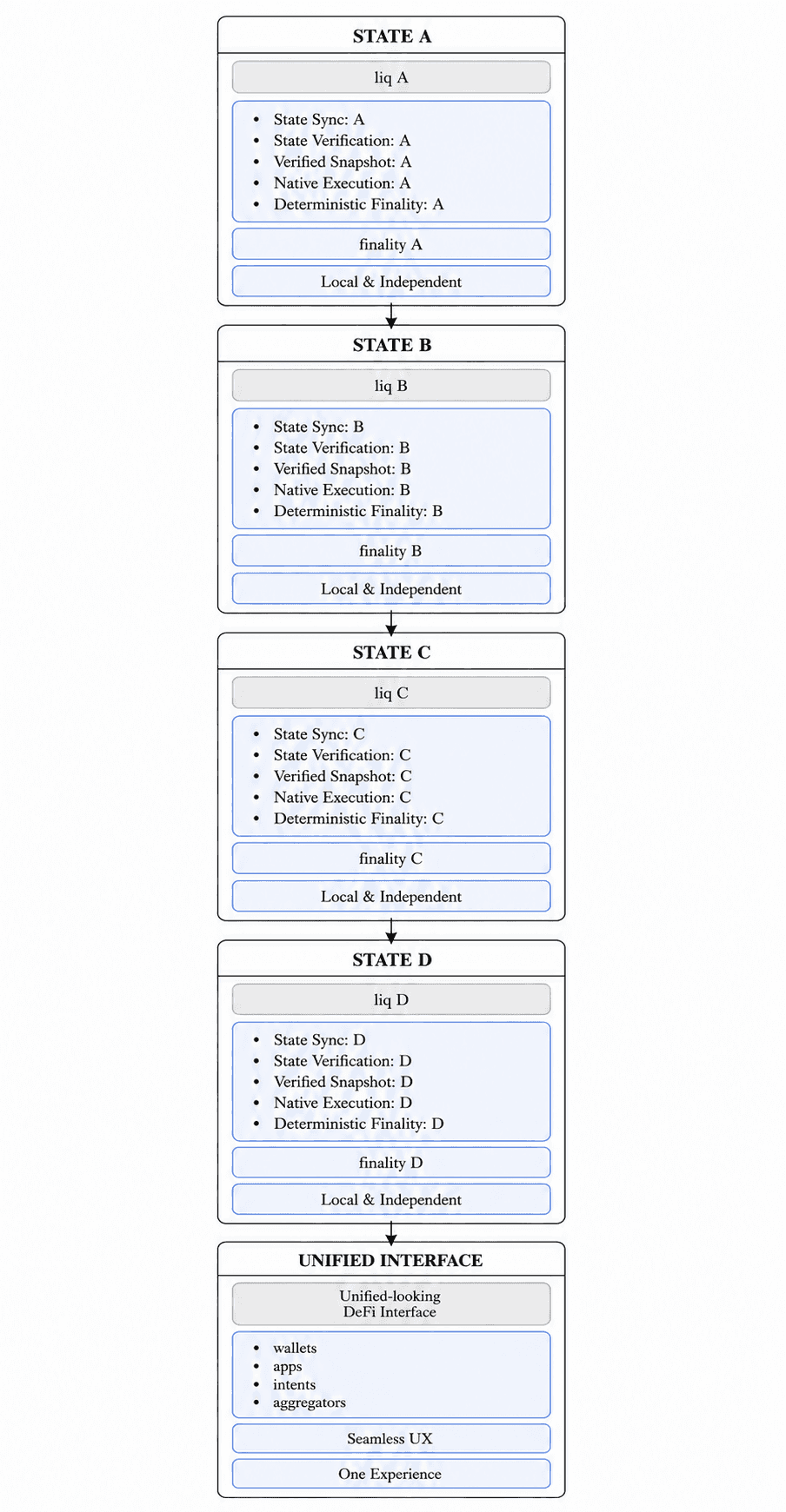
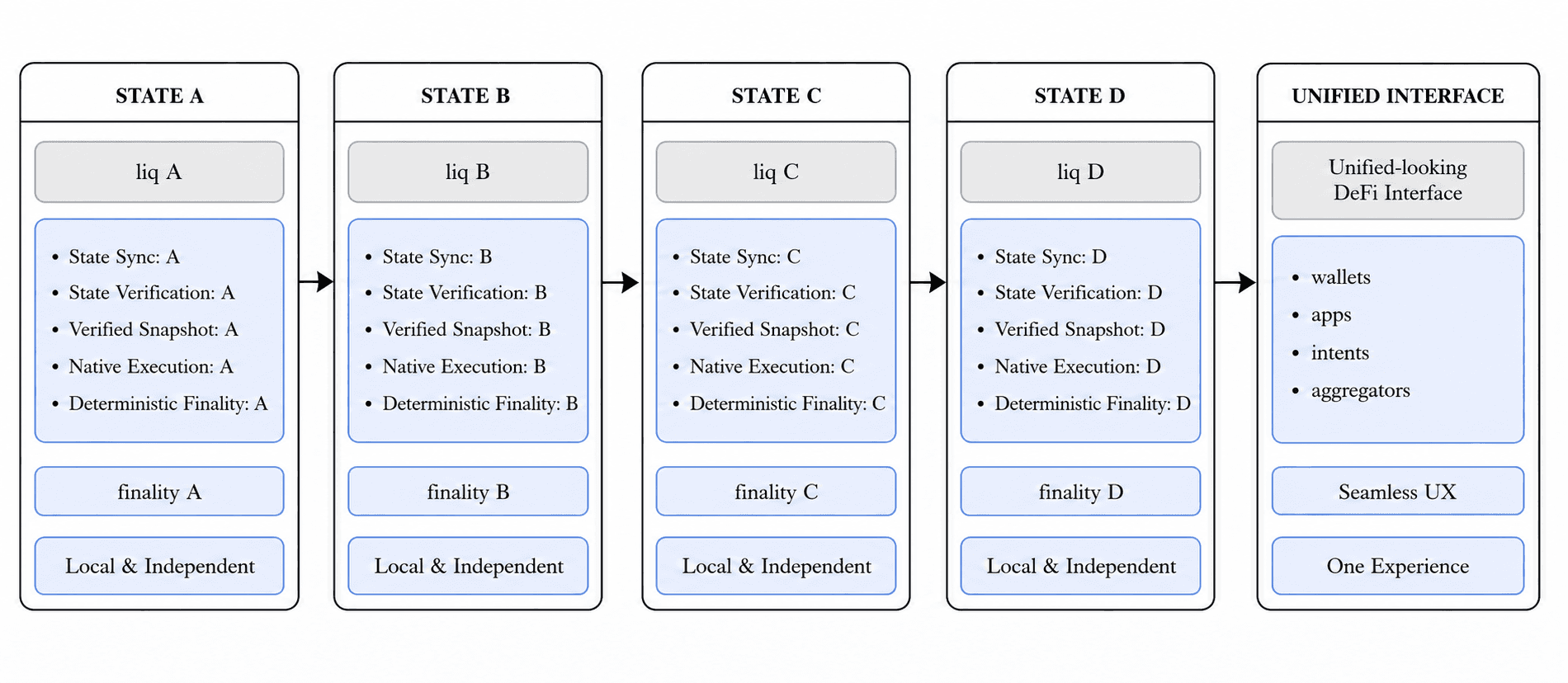
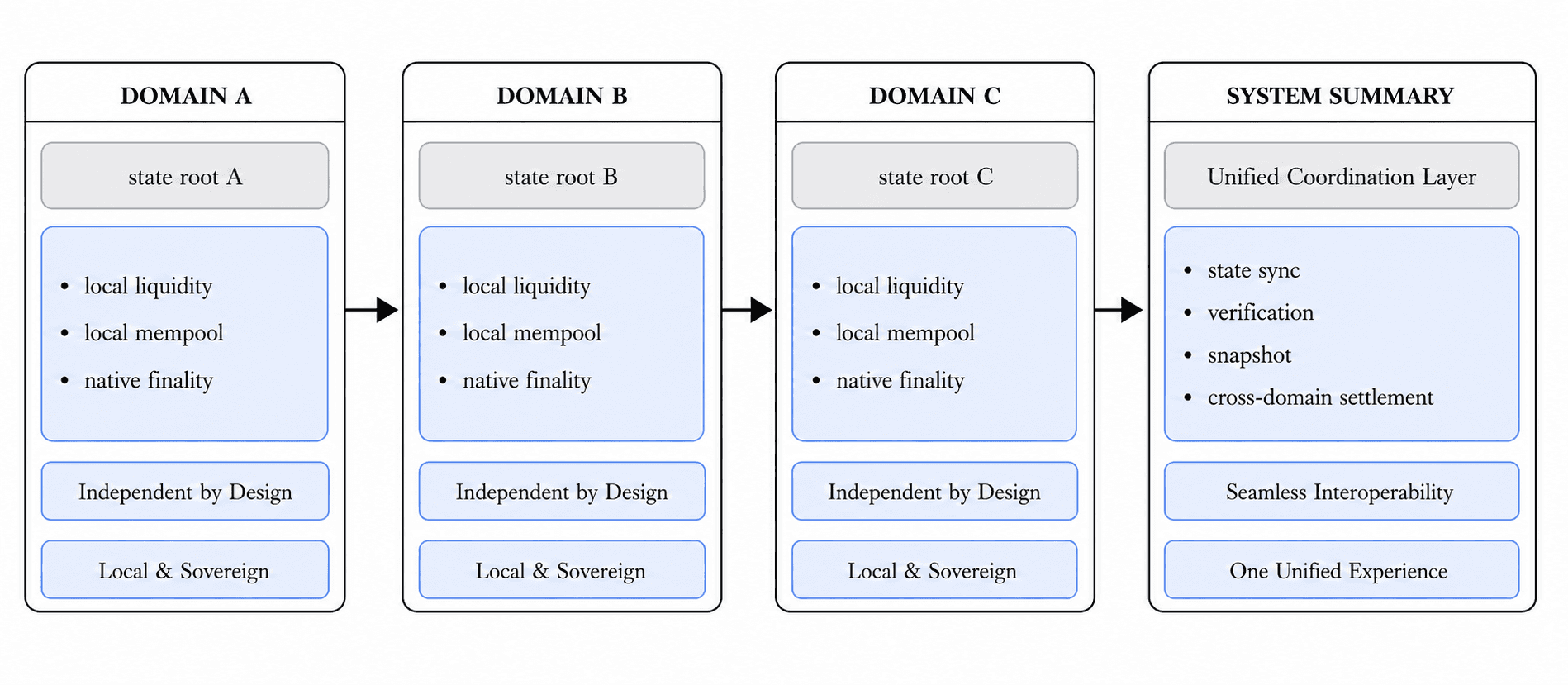
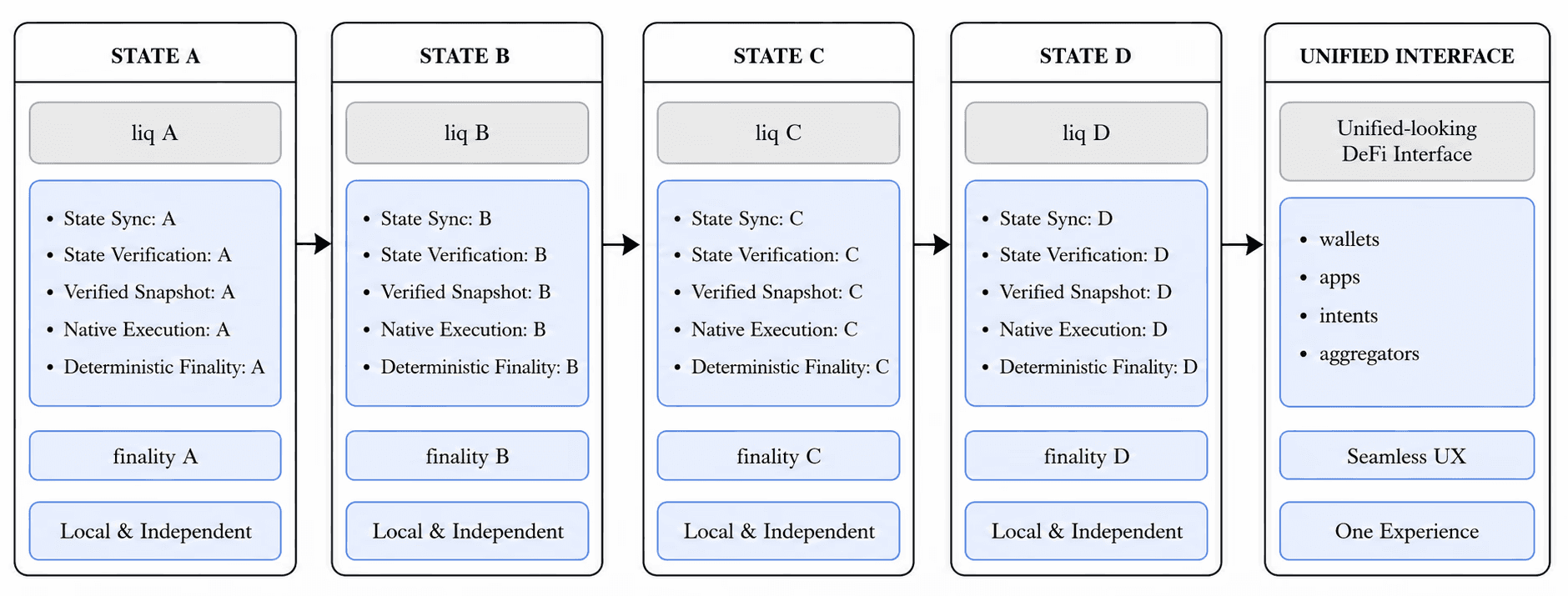
This is the central structural problem: DeFi did not become inefficient because liquidity is distributed; it became structurally fragile because distributed liquidity is coordinated through routing, bridging, intermediaries, and probabilistic state assumptions rather than through verified synchronized state.
This is the core structural problem: DeFi became fragile not because liquidity is distributed, but because it is coordinated through routing, bridges, intermediaries, and probabilistic assumptions rather than verified synchronized state.
Beyond Multi-Chain
Fragmentation is often misunderstood as the simple presence of many chains. That definition is incomplete. Multiple blockchain environments are not inherently a problem. They become a problem when transaction coordination depends on isolated state machines without a shared verification layer.
Beyond Multi-Chain
Fragmentation is not simply the existence of many chains. It emerges when transaction coordination depends on isolated state machines without a shared verification layer.
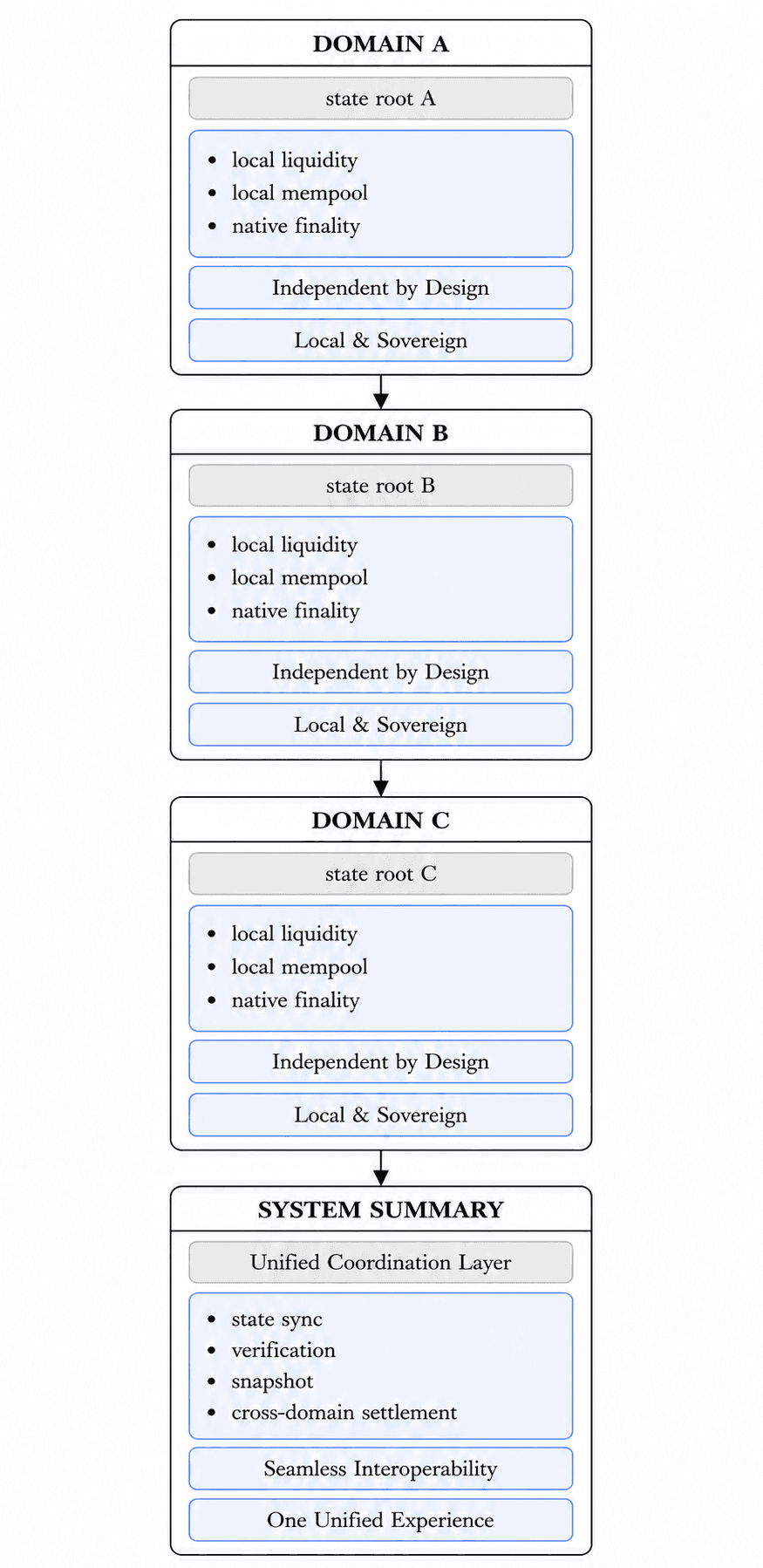
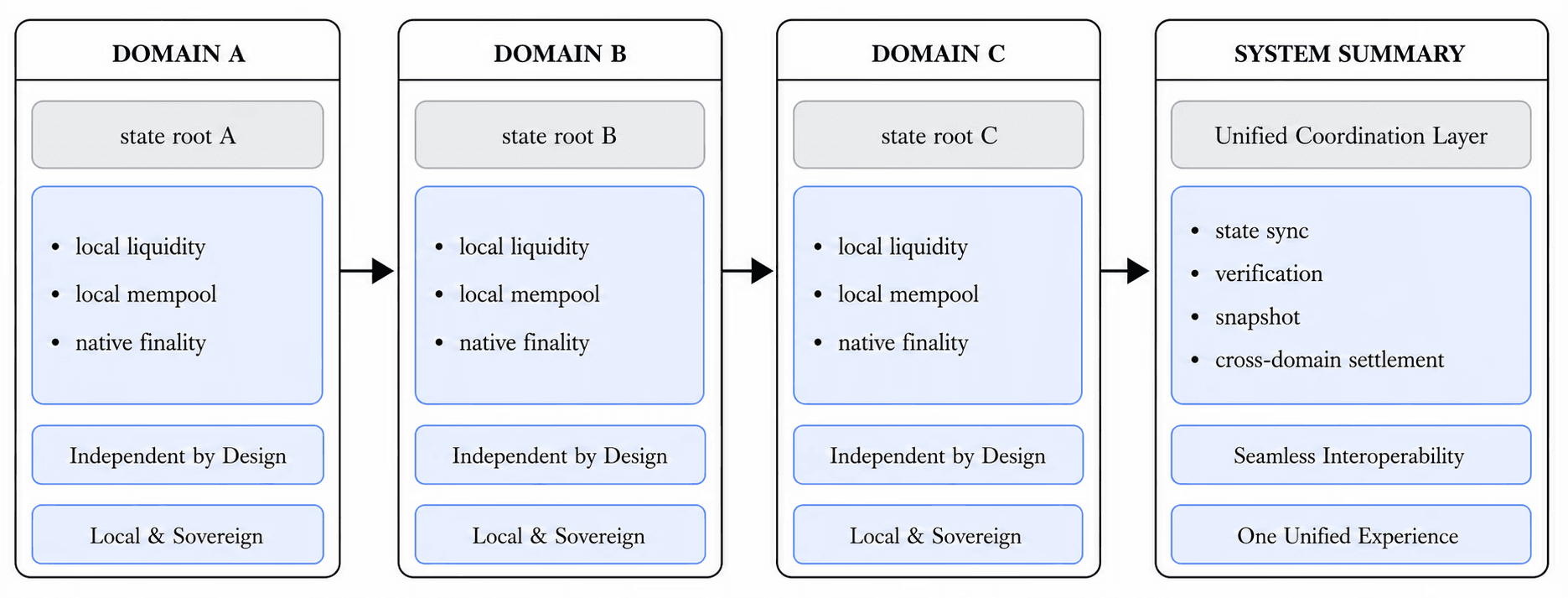
A blockchain environment is a local deterministic system. It maintains its own:
1.
state;
2.
liquidity;
3.
ordering rules;
4.
finality model;
5.
mempool structure;
6.
fee market;
7.
consensus assumptions;
8.
virtual-machine semantics.
1.
state;
2.
liquidity;
3.
ordering rules;
4.
finality model;
5.
mempool structure;
6.
fee market;
7.
consensus assumptions;
8.
virtual-machine semantics.
The problem begins when one transaction depends on more than one of these domains.
A transaction cannot safely assume that state observed on Chain A remains valid on Chain B. It cannot assume that liquidity remains available after a route is constructed. It cannot assume that finality occurs on the same timeline. It cannot assume that public transaction exposure will not alter the conditions before confirmation.
A transaction cannot assume state validity across chains, persistent liquidity, synchronized finality, or that public exposure will not alter execution conditions before confirmation.
A chain should not be treated only as a venue where liquidity exists. From a transaction-coordination perspective, each chain is a separate state domain with its own timing, finality, ordering, and liquidity conditions.
A chain is not just a liquidity venue. It is a distinct state domain with its own timing, finality, ordering, and liquidity conditions.
Liquidity Fragmentation
Liquidity fragmentation occurs when capital is distributed across isolated environments without a common state model. In current infrastructure, this is handled primarily through path construction.
The problem begins when one transaction depends on more than one of these domains.
That means transaction systems must ask:
Which venue has available liquidity?
Which route can access it?
Which bridge or representation is required?
Which intermediary can coordinate the path?
Which solver can absorb uncertainty?
Which state assumptions remain valid long enough for the transaction to complete?
Which venue has available liquidity?
Which route can access it?
Which bridge or representation is required?
Which intermediary can coordinate the path?
Which solver can absorb uncertainty?
Which state assumptions remain valid long enough for the transaction to complete?
This turns distributed liquidity into a routing problem. The deeper issue is that routing does not synchronize state. It only attempts to navigate between disconnected state domains.
⟵ Scroll right/left ⟶
⟵ Scroll right/left ⟶
Fragmented Surface
Current Workaround and Structural Limit
Dispersion
Aggregators search for paths across distributed liquidity venues, but route quality depends on stale or shifting state rather than a verified synchronized snapshot.
Transfer
Bridges move asset representations between domains, but movement does not create unified transaction state or native finality coordination.
Uncertainty
Solvers absorb fulfillment risk, but transaction correctness is outsourced to intermediary incentives rather than guaranteed by protocol-level state verification.
Exposure
Private RPC can partially hide submission, but privacy alone does not synchronize downstream liquidity, ordering, or finality conditions.
Asymmetry
Systems wait, retry, or reprice, but confirmation timing remains uneven across networks and the transaction outcome remains probabilistic until local states converge.
Fragmented Surface
Current Workaround and Structural Limit
Dispersion
Aggregators search for paths across distributed liquidity venues, but route quality depends on stale or shifting state rather than a verified synchronized snapshot.
Transfer
Bridges move asset representations between domains, but movement does not create unified transaction state or native finality coordination.
Uncertainty
Solvers absorb fulfillment risk, but transaction correctness is outsourced to intermediary incentives rather than guaranteed by protocol-level state verification.
Exposure
Private RPC can partially hide submission, but privacy alone does not synchronize downstream liquidity, ordering, or finality conditions.
Asymmetry
Systems wait, retry, or reprice, but confirmation timing remains uneven across networks and the transaction outcome remains probabilistic until local states converge.
Distributed liquidity is inevitable. The infrastructure failure is not that liquidity is local; it is that transaction coordination treats local liquidity as something to be routed through instead of something to be synchronized against.
Distributed liquidity is inevitable. The failure is not local liquidity itself, but coordinating it through routing rather than synchronized state.
State Isolation
Without shared transaction state, every multi-domain transaction becomes probabilistic. Quotes, routes, bridge confirmations, solver commitments, and private order submission channels are all approximations unless they are anchored to verified state conditions.
The absence of shared transaction state creates four systemic consequences:
1.
State uncertainty: The transaction is constructed against information that may no longer be valid at the point of processing.
State uncertainty:
2.
Ordering exposure: Public or semi-public transaction flow can be observed, reordered, delayed, or acted upon before confirmation.
Ordering exposure:
3.
Finality mismatch: Different networks confirm transactions under different timing, validator, sequencer, or consensus assumptions.
Finality mismatch:
4.
Coordination dependency: External systems must bridge the gap between transaction intent and transaction outcome.
Coordination dependency:
1.
State uncertainty: The transaction is constructed against information that may no longer be valid at the point of processing.
State uncertainty:
2.
Ordering exposure: Public or semi-public transaction flow can be observed, reordered, delayed, or acted upon before confirmation.
Ordering exposure:
3.
Finality mismatch: Different networks confirm transactions under different timing, validator, sequencer, or consensus assumptions.
Finality mismatch:
4.
Coordination dependency: External systems must bridge the gap between transaction intent and transaction outcome.
Coordination dependency:
A system can connect chains, move messages, transfer wrapped assets, and compute routes while still failing to coordinate deterministic transaction outcomes. Connectivity improves access. It does not create synchronized state.
A system can connect chains, transfer assets, and route messages yet still fail to ensure deterministic outcomes. Connectivity improves access, not state synchronization.
Liquidity Fragmentation
Decentralized finance has scaled to trillions in transaction activity, reaching $4.86T in addressable on-chain volume, $1.9T in target transaction flow, and $400B in capturable market opportunity. However, fragmented liquidity, reliance on external coordination systems, and invisible value extraction through MEV and slippage remain structural inefficiencies, compounded by more than $2.8B lost to exploits since 2022.
⟵ Scroll right/left ⟶
Fragmentation Signal
Infrastructure Interpretation
Multi-trillion volume
Coordination failure scales with transaction density, not only user count.
Cross-Domain Liquidity
Capital remains native and local while transaction demand becomes network-agnostic.
Public exposure
Transaction flow becomes an information surface before finality.
Intermediary reliance
Cross-domain activity depends on external trust, latency, and representation layers.
No deterministic state
Outcomes remain probabilistic until local confirmations occur.
Fragmentation Signal
Infrastructure Interpretation
Multi-trillion volume
Coordination failure scales with transaction density, not only user count.
Cross-Domain Liquidity
Capital remains native and local while transaction demand becomes network-agnostic.
Public exposure
Transaction flow becomes an information surface before finality.
Intermediary reliance
Cross-domain activity depends on external trust, latency, and representation layers.
No deterministic state
Outcomes remain probabilistic until local confirmations occur.
These figures are not merely market indicators. They describe the scale at which path-dependent infrastructure becomes systemically expensive. At sufficient transaction density, routing, bridging, slippage tolerance, solver spreads, and MEV exposure are no longer edge cases. They become embedded costs of the architecture.
These metrics reflect more than market growth. They expose the structural cost of path-dependent infrastructure at scale. As transaction volume increases, routing, bridging, slippage, solver spreads, and MEV extraction evolve from isolated inefficiencies into persistent architectural costs.