
Whitepaper
v1.4
Whitepaper
v1.4
Rokz Protocol
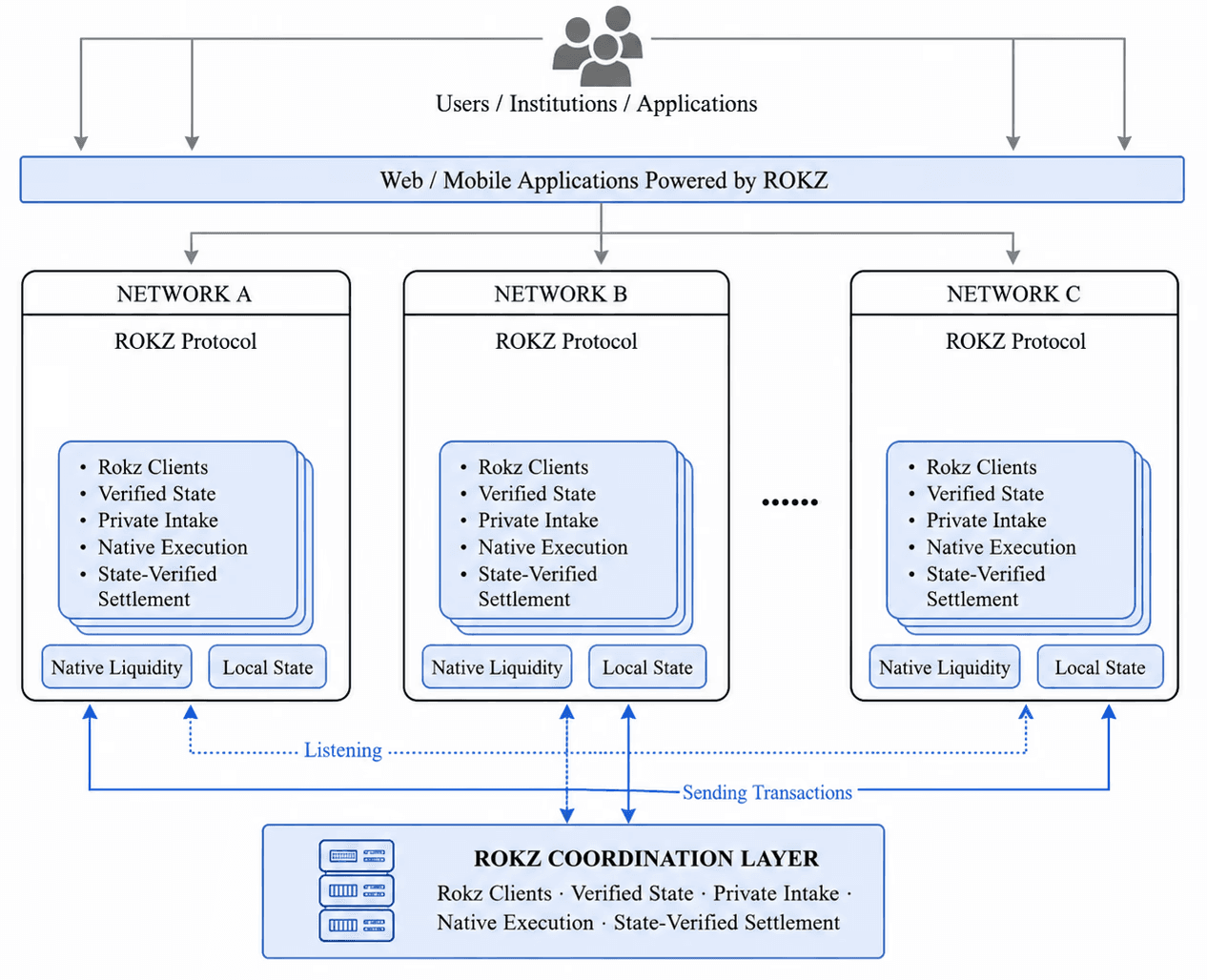
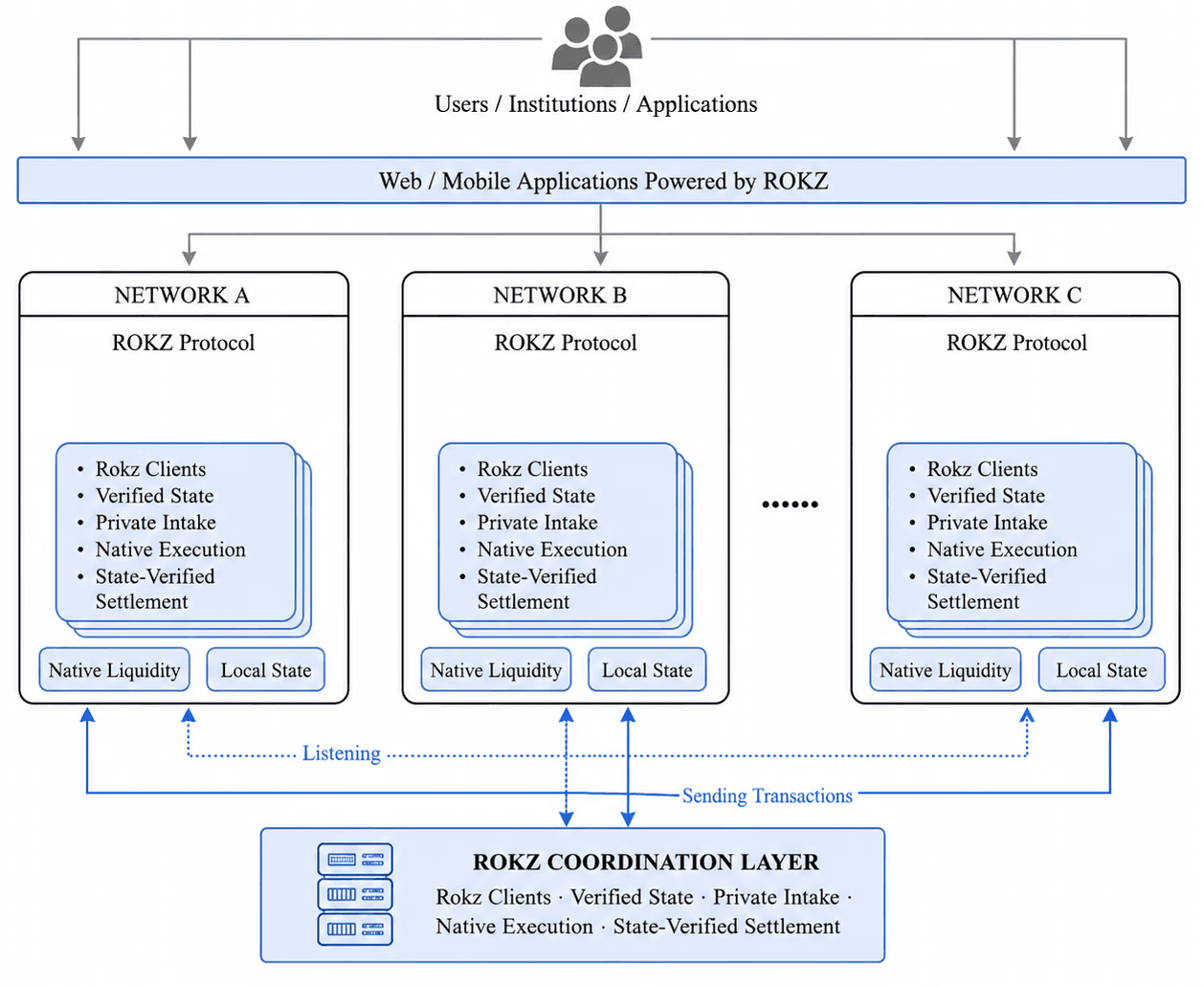
Rokz Protocol is the architectural response to the execution failures defined in the previous chapters: incompatible networks, fragmented liquidity, isolated state environments, MEV exposure, slippage, settlement delays, intermediary dependency, and probabilistic execution.
Rokz is not another interoperability tool. It does not attempt to make fragmented systems more navigable. It restructures execution itself.
The core distinction is simple:
Core distinction:
⟵ Scroll right/left ⟶
Legacy Infrastructure
Rokz Protocol
Coordinates around fragmentation externally
Internalizes coordination into execution architecture.
Depends on path construction
Executes through verified state.
Uses bridges and wrapped representations
Coordinates native local liquidity.
Relies on solvers and intermediaries
Coordinates through Rokz Clients.
Exposes transaction flow
Preserves private transaction intake.
Finalizes probabilistically
Finalizes through state-verified settlement.
Legacy Infrastructure
Rokz Protocol
Coordinates around fragmentation externally
Internalizes coordination into execution architecture.
Depends on path construction
Executes through verified state.
Uses bridges and wrapped representations
Coordinates native local liquidity.
Relies on solvers and intermediaries
Coordinates through Rokz Clients.
Exposes transaction flow
Preserves private transaction intake.
Finalizes probabilistically
Finalizes through state-verified settlement.
The Rokz architecture is built around three primary principles:
Rokz is built on three principles:
1.
Unified execution layer: Eliminates chain incompatibility at the protocol-logic level.
Unified execution layer:
2.
Deterministic execution: Positions execution around verified state, near-zero slippage, and MEV-resistant transaction flow.
Deterministic execution:
3.
No intermediary dependency: Removes routing, bridging, external aggregation, and solver-controlled execution from the core transaction model.
No intermediary dependency:
1.
Unified execution layer: Eliminates chain incompatibility at the protocol-logic level.
Unified execution layer:
2.
Deterministic execution: Positions execution around verified state, near-zero slippage, and MEV-resistant transaction flow.
Deterministic execution:
3.
No intermediary dependency: Removes routing, bridging, external aggregation, and solver-controlled execution from the core transaction model.
No intermediary dependency:
Rokz should not be evaluated as a DEX, bridge, aggregator, router, solver network, or messaging protocol. Those systems operate inside fragmented infrastructure. Rokz defines the coordination substrate beneath it.
Rokz is not a DEX, bridge, aggregator, router, solver network, or messaging protocol. Those operate within fragmentation; Rokz provides the coordination layer.
Rokz is not improving the old execution stack. It is replacing the dependency model underneath it: routes, bridges, public flow, and intermediary-controlled coordination.
Rokz is not improving the old execution stack. It replaces its dependency model: routes, bridges, public flow, and intermediary-controlled coordination.
On this page