
Whitepaper
v1.4
Whitepaper
v1.4
Context
DeFi’s fragmentation is not a surface-level liquidity issue, but the structural outcome of scaling transaction activity across incompatible state machines: every new chain, rollup, VM, and liquidity venue expands capacity and specialization while forcing transaction flow back into routing, bridging, wrapped representations, solvers, and other intermediary coordination layers, turning “interoperability” into a workaround rather than a unified processing model.
Context
DeFi fragmentation is the structural result of scaling activity across incompatible state machines. Every new chain, rollup, VM, and liquidity venue increases capacity and specialization, but also forces execution through bridges, routing, wrapped assets, solvers, and other coordination layers, making interoperability a workaround rather than a unified execution model.
Underneath that workaround remains a probabilistic coordination stack — aggregators searching for paths, bridges moving representations, solvers absorbing uncertainty, and public or semi-public transaction flow exposed to MEV, slippage, state drift, and finality mismatch — which is why Rokz is built for the point where this architecture reaches its ceiling: replacing routed, bridged, intermediary-dependent transaction logic with deterministic state synchronization across incompatible environments, where native liquidity processing is triggered only after conditions are verified through a unified coordination layer.
Beneath this workaround remains a probabilistic coordination stack: aggregators search for paths, bridges move asset representations, solvers absorb uncertainty, and transaction flow remains exposed to MEV, slippage, state drift, and finality mismatches. Rokz addresses the limits of this architecture by replacing routed, bridge-dependent execution with deterministic state synchronization, where native liquidity processing begins only after conditions are verified through a unified coordination layer.
Multi-Chain Evolution
Multi-chain DeFi scaled through fragmented liquidity, bridges, routers, aggregators, and interoperability layers, but every additional chain and coordination layer increased routing complexity, slippage, MEV exposure, intermediary dependency, fragmented state, and incompatible transaction conditions, leaving the industry with more connectivity yet without deterministic coordination across blockchain environments.
Connectivity was mistaken for coordination. Interoperability made blockchain environments reachable, but never made transaction conditions deterministic across chains.
Chain Heterogeneity
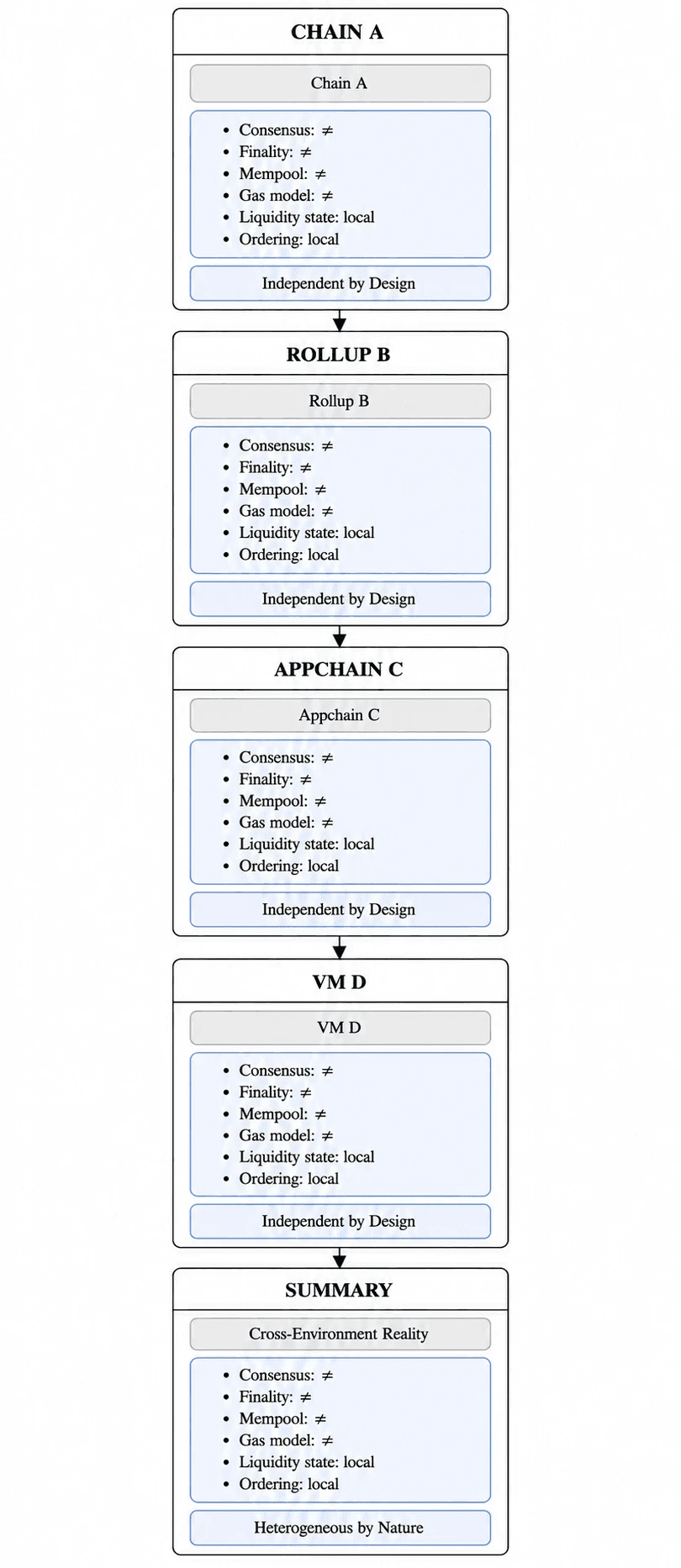
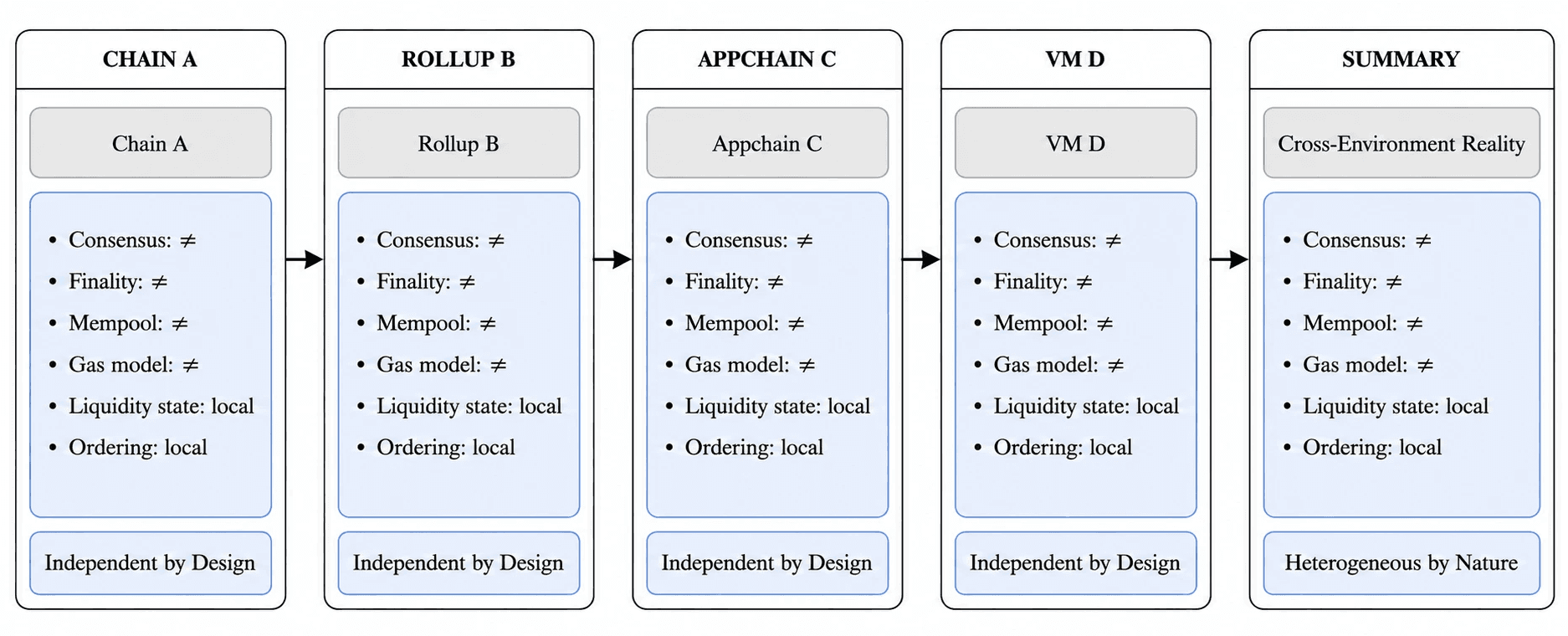
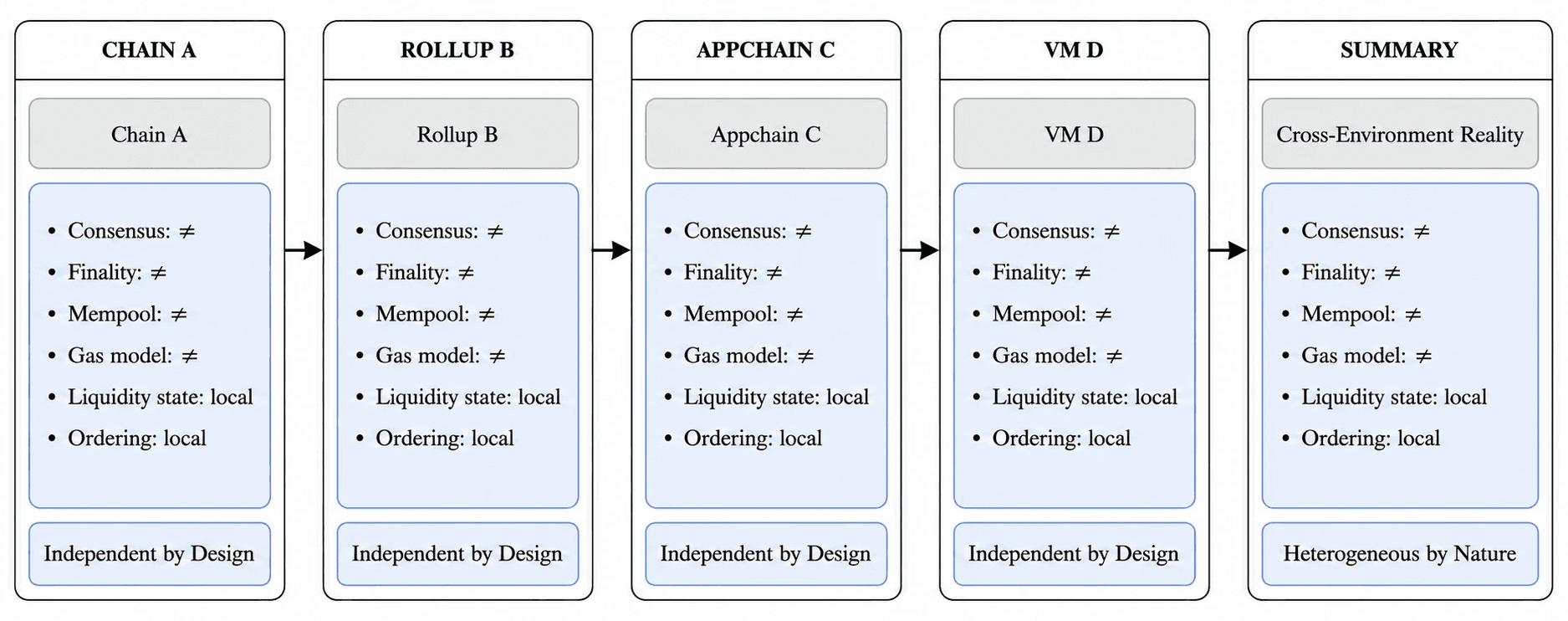
Modern blockchain environments evolved as isolated transaction domains with independent consensus models, fragmented liquidity, local mempool exposure, incompatible transaction ordering, and chain-specific coordination logic. These differences are structural and directly impact slippage exposure, MEV extraction, bridge dependency, routing complexity, intermediary reliance, and deterministic transaction conditions across chains.
A cross-chain transaction must continuously reason about:
1.
State Synchronization: Ensuring observed blockchain data remains current and consistent across incompatible blockchains.
State Synchronization:
2.
Stable Local Liquidity: Evaluating available liquidity and minimizing pricing volatility during execution.
Stable Local Liquidity:
3.
Public Flow Exposure: Accounting for mempool transparency and potential extraction risks.
Public Flow Exposure:
4.
Cross-Chain Finality: Understanding when transactions become irreversible on different networks.
Cross-Chain Finality:
5.
Chain Failure States: Identifying operational risks unique to each blockchain environment.
Chain Failure States:
6.
Execution Sequencing Risks: Managing execution dependencies and ordering manipulation threats.
Execution Sequencing Risks:
7.
Coordination Constraints: Handling interoperability limitations imposed by individual protocols.
Coordination Constraints:
8.
Confirmation Latency: Reducing delays between detected state changes and finalized execution.
Confirmation Latency:
1.
State freshness and synchronization: Ensuring observed blockchain data remains current and consistent across networks
State freshness and synchronization:
1.
State freshness and synchronization: Ensuring observed blockchain data remains current and consistent across networks
State freshness and synchronization:
2.
Local liquidity depth and pricing stability: Evaluating available liquidity and minimizing pricing volatility during execution.
Local liquidity depth and pricing stability:
2.
Local liquidity depth and pricing stability: Evaluating available liquidity and minimizing pricing volatility during execution.
Local liquidity depth and pricing stability:
3.
Pending transaction visibility and MEV exposure: Accounting for mempool transparency and potential extraction risks.
Pending transaction visibility and MEV exposure:
3.
Pending transaction visibility and MEV exposure: Accounting for mempool transparency and potential extraction risks.
Pending transaction visibility and MEV exposure:
4.
Finality thresholds across chains: Understanding when transactions become irreversible on different networks.
Finality thresholds across chains:
4.
Finality thresholds across chains: Understanding when transactions become irreversible on different networks.
Finality thresholds across chains:
5.
Chain-specific failure conditions: Identifying operational risks unique to each blockchain environment.
Chain-specific failure conditions:
5.
Chain-specific failure conditions: Identifying operational risks unique to each blockchain environment.
Chain-specific failure conditions:
6.
Sequencing and transaction-ordering risks: Managing execution dependencies and ordering manipulation threats.
Sequencing and transaction-ordering risks:
6.
Sequencing and transaction-ordering risks: Managing execution dependencies and ordering manipulation threats.
Sequencing and transaction-ordering risks:
7.
Protocol-specific coordination constraints: Handling interoperability limitations imposed by individual protocols.
Protocol-specific coordination constraints:
7.
Protocol-specific coordination constraints: Handling interoperability limitations imposed by individual protocols.
Protocol-specific coordination constraints:
8.
Latency between state observation and confirmation: Reducing delays between detected state changes and finalized execution.
Latency between state observation and confirmation:
8.
Latency between state observation and confirmation: Reducing delays between detected state changes and finalized execution.
Latency between state observation and confirmation:
Traditional infrastructure relies on bridges, routing layers, aggregators, relayers, and solver systems to coordinate fragmented blockchain environments, while Rokz replaces routed coordination with verified state synchronization through Rokz Clients before transaction processing begins, enabling deterministic coordination across heterogeneous chains.
Traditional infrastructure relies on bridges, routing layers, aggregators, relayers, and solver systems to coordinate fragmented blockchain environments, while Rokz replaces routed coordination with verified state synchronization through Rokz Clients before transaction processing begins, enabling deterministic coordination across heterogeneous chains.
Traditional infrastructure coordinates fragmented blockchains through bridges, routers, aggregators, relayers, and solvers. Rokz replaces this with verified state synchronization via Rokz Clients, enabling deterministic coordination across heterogeneous chains.
Traditional infrastructure coordinates fragmented blockchain environments through bridges, routing layers, aggregators, and solver systems exposed to slippage, MEV extraction, intermediary dependency, and incompatible transaction conditions across chains. Rokz replaces routed coordination with verified state synchronization through Rokz Clients, enabling deterministic coordination across heterogeneous blockchain environments without bridge or intermediary dependency.
Traditional infrastructure coordinates fragmented blockchains through bridges, routing, aggregators, and solvers, exposing execution to slippage, MEV, intermediary dependency, and incompatible conditions. Rokz replaces this with verified state synchronization via Rokz Clients, enabling deterministic coordination across heterogeneous chains without bridges or intermediaries.
Chain Heterogeneity
Modern blockchain environments evolved as isolated transaction domains with independent consensus models, fragmented liquidity, local mempool exposure, incompatible transaction ordering, and chain-specific coordination logic. These differences are structural and directly impact slippage exposure, MEV extraction, bridge dependency, routing complexity, intermediary reliance, and deterministic transaction conditions across chains.
Cross-Chain Coordination
As liquidity expanded across blockchain environments, DeFi introduced bridges, aggregators, relayers, solvers, and routing systems to coordinate fragmented transaction flow between chains. These architectures improved access, but preserved isolated state, intermediary dependency, asynchronous coordination, slippage exposure, MEV extraction, and incompatible transaction conditions across networks. Rokz reframes cross-chain coordination through Rokz Clients — a verification and synchronization layer that establishes deterministic transaction coordination across heterogeneous blockchain environments before processing begins.
Cross-Chain Coordination
As DeFi expanded across chains, bridges, aggregators, relayers, solvers, and routing systems improved access but preserved fragmentation, intermediary dependency, slippage, MEV exposure, and incompatible transaction conditions. Rokz addresses this through Rokz Clients, a verification and synchronization layer enabling deterministic coordination across heterogeneous blockchain environments before execution begins.
Bridges move representations rather than synchronized state, routing systems optimize fragmented paths instead of deterministic coordination, and relayers depend on asynchronous messaging. Rokz replaces fragmented coordination with verified state synchronization across blockchain environments.
Bridges move asset representations, routers optimize fragmented paths, and relayers depend on asynchronous messaging. Rokz replaces them with verified state synchronization across blockchain environments.
Liquidity Across Ecosystems
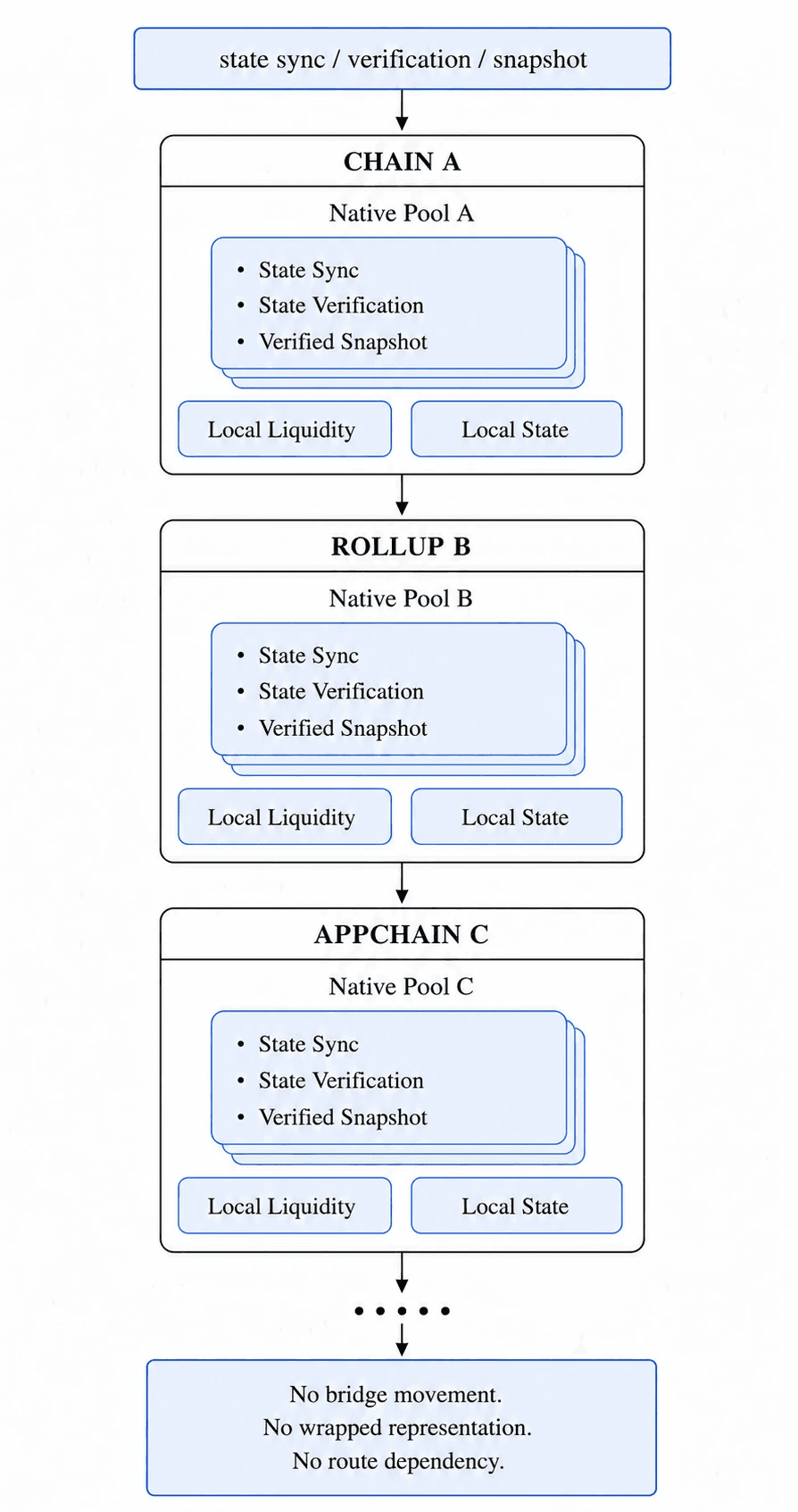
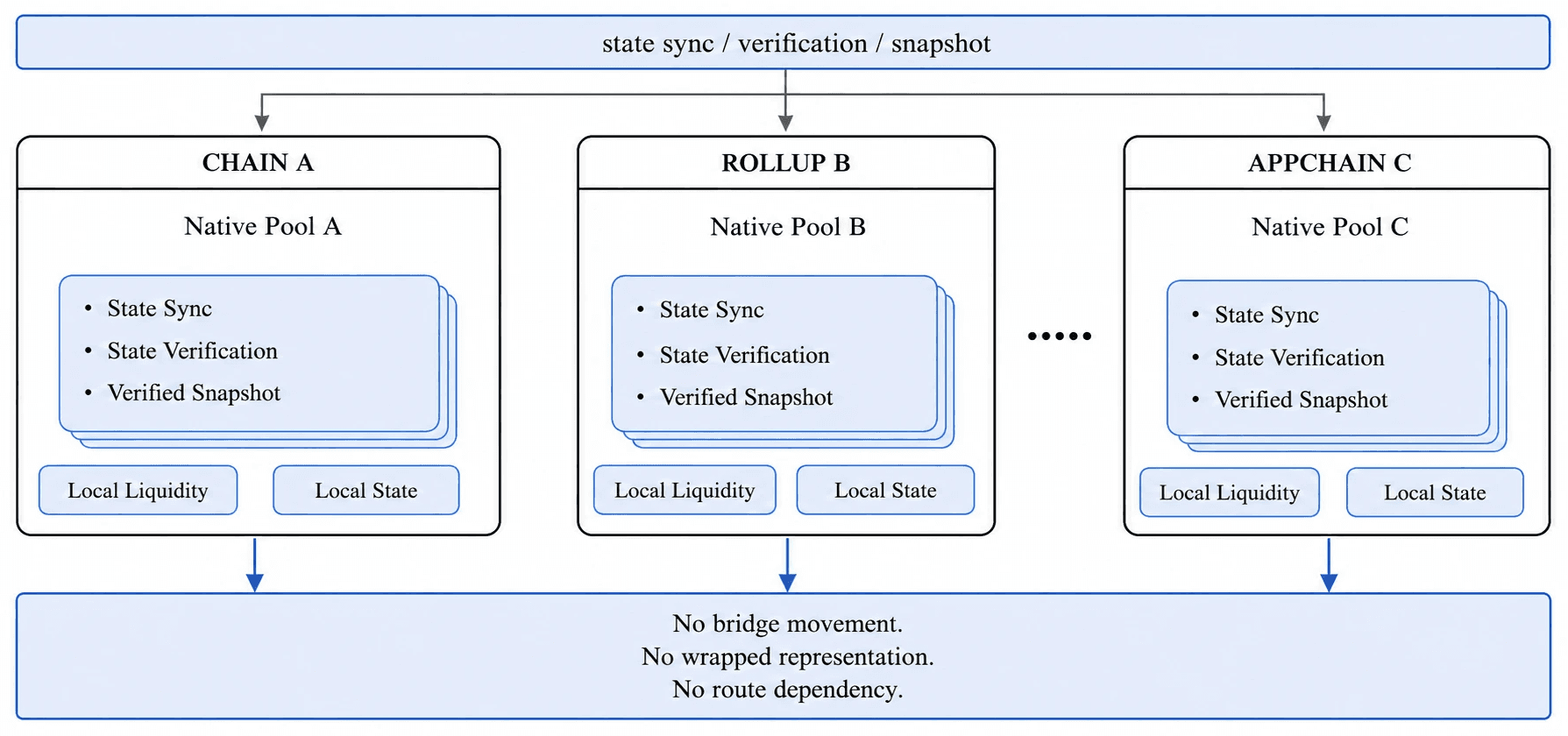
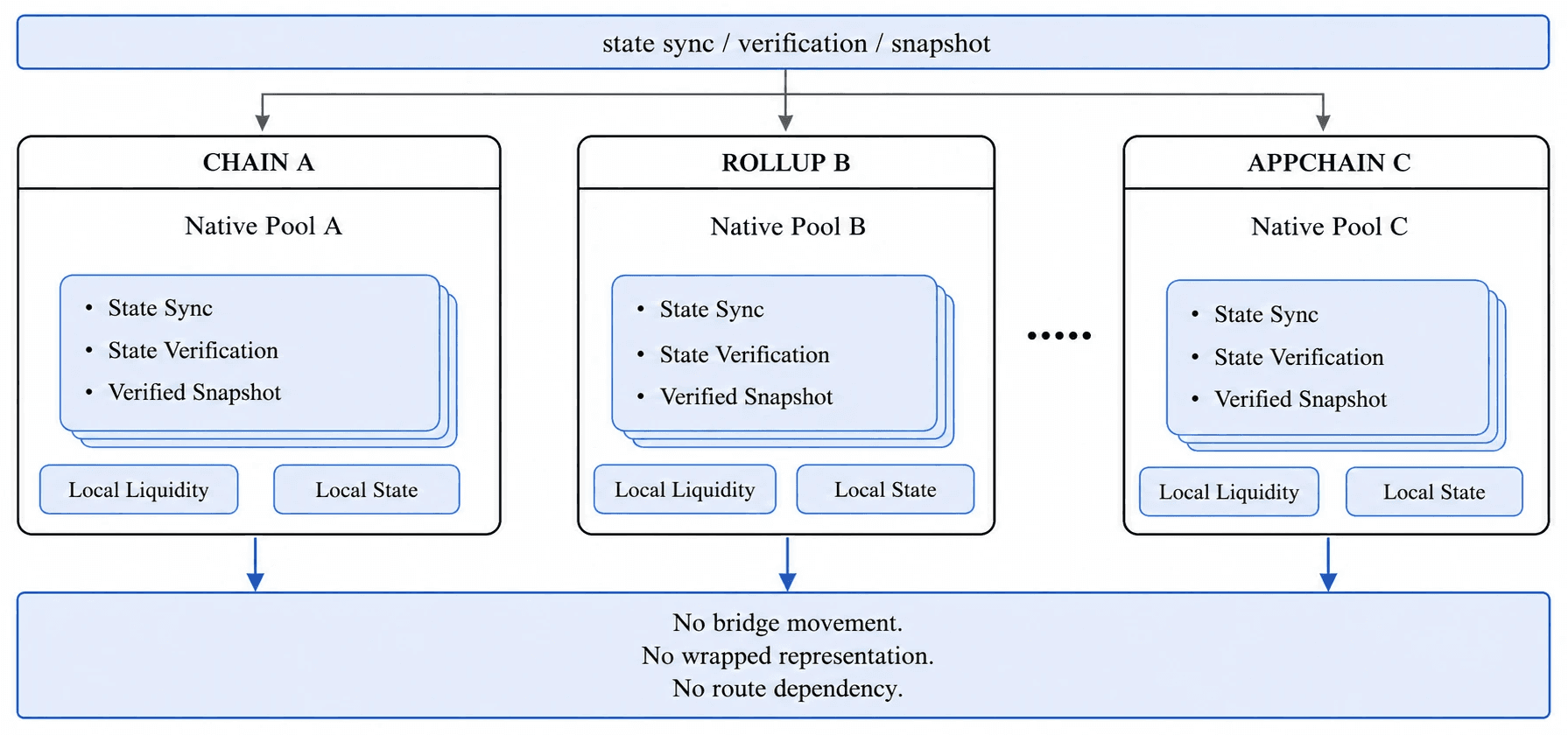
DeFi liquidity is fragmented across chains, rollups, and isolated ecosystems, creating routing complexity, bridge dependency, slippage, MEV exposure, and poor transaction coordination. Aggregators and bridges can find liquidity but cannot synchronize the shared state needed for deterministic coordination. Rokz preserves local liquidity through Rokz Clients — a verification and synchronization layer that establishes shared blockchain state before processing, enabling coordination without bridges or intermediaries.
Unified Liquidity Access
DeFi liquidity is fragmented across chains, creating routing complexity, bridge dependency, slippage, MEV exposure, and poor coordination. Aggregators and bridges can access liquidity but cannot synchronize shared state. Rokz uses Rokz Clients to verify and synchronize state before execution, enabling coordination without bridges or intermediaries.
Fragmented Execution
Modern DeFi operates as fragmented transaction coordination hidden behind an interoperability interface. Bridges, aggregators, routing systems, relayers, and intent layers improved access across chains, but transaction flow still depends on isolated state, fragmented liquidity, local mempool exposure, routing delays, bridge dependency, slippage, MEV extraction, and intermediary-controlled coordination across incompatible blockchain environments.
Connectivity was mistaken for coordination. Interoperability made blockchain environments reachable, but never made transaction conditions deterministic across chains.
Fragmented Execution
Modern DeFi hides fragmented coordination behind interoperability. Bridges, aggregators, routers, relayers, and intent layers improve access, but execution still depends on isolated state, fragmented liquidity, mempool exposure, routing delays, bridge dependency, slippage, MEV, and intermediary-controlled coordination across incompatible chains.
Connectivity was mistaken for coordination. Interoperability made chains reachable, but not transaction conditions deterministic across them.