Rokz Clients

Rokz Clients are the core infrastructure primitive of Rokz Protocol.

Without Rokz Clients, Rokz is only a coordination thesis. With Rokz Clients, the protocol becomes executable infrastructure.

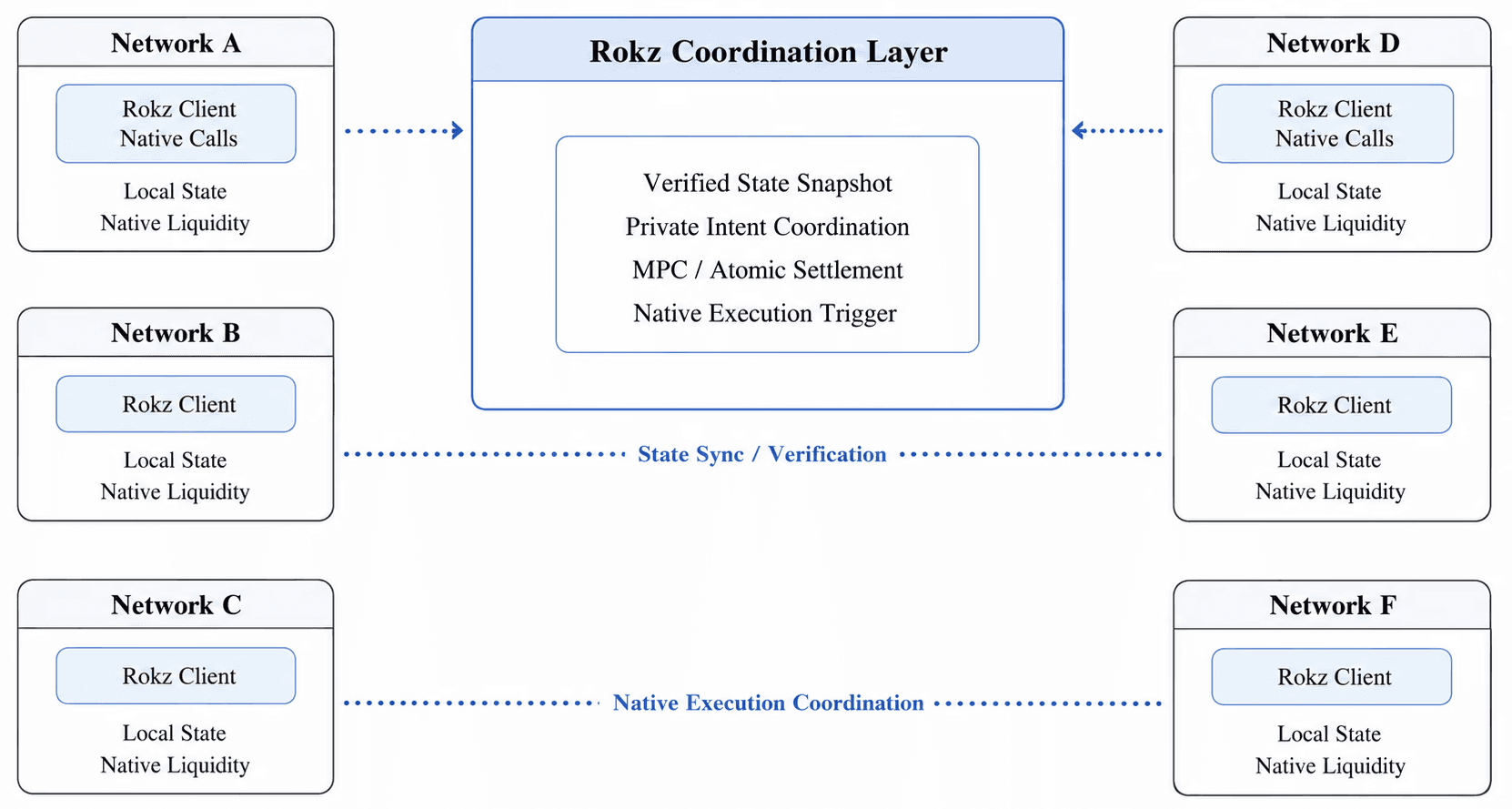
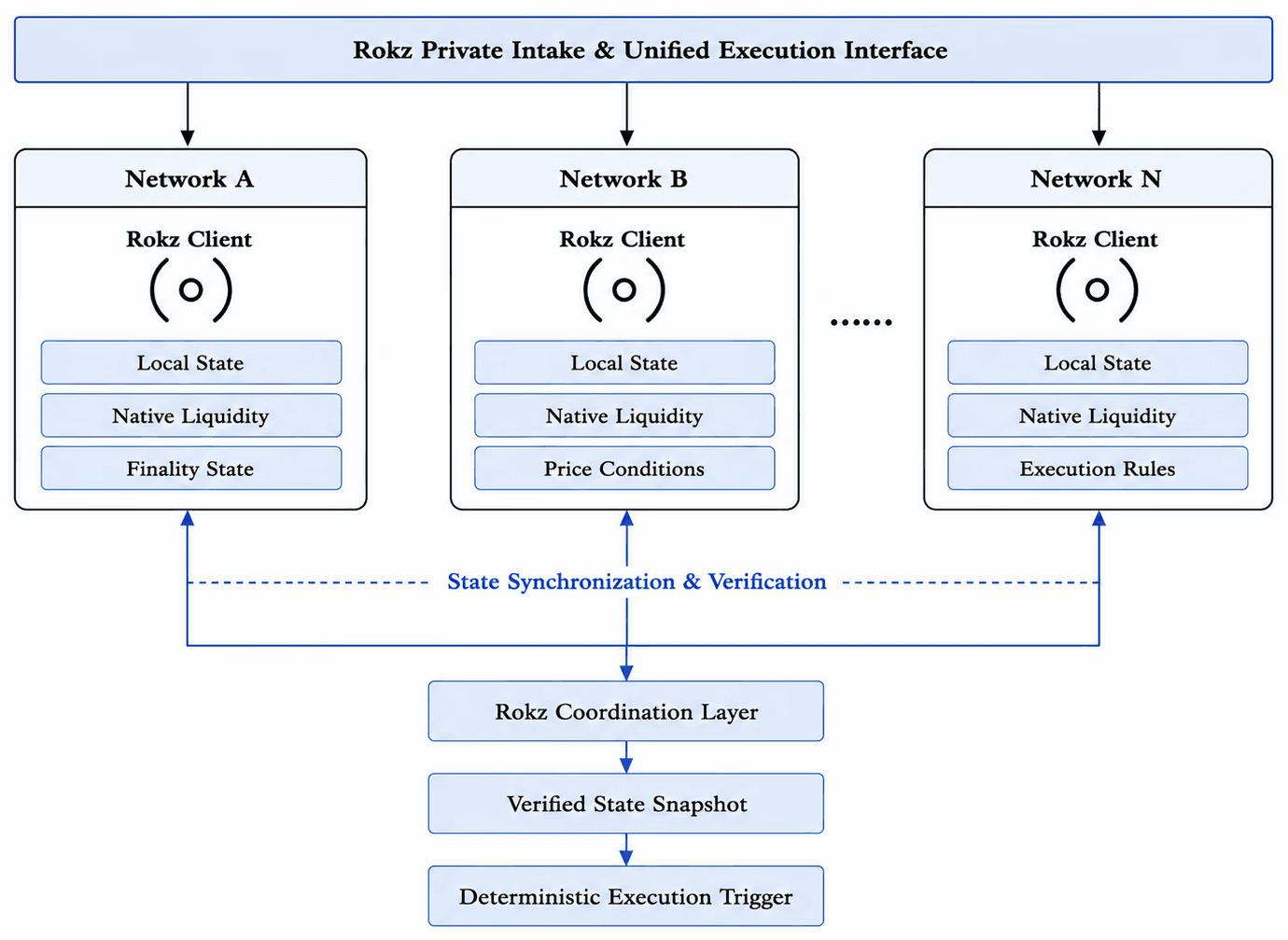
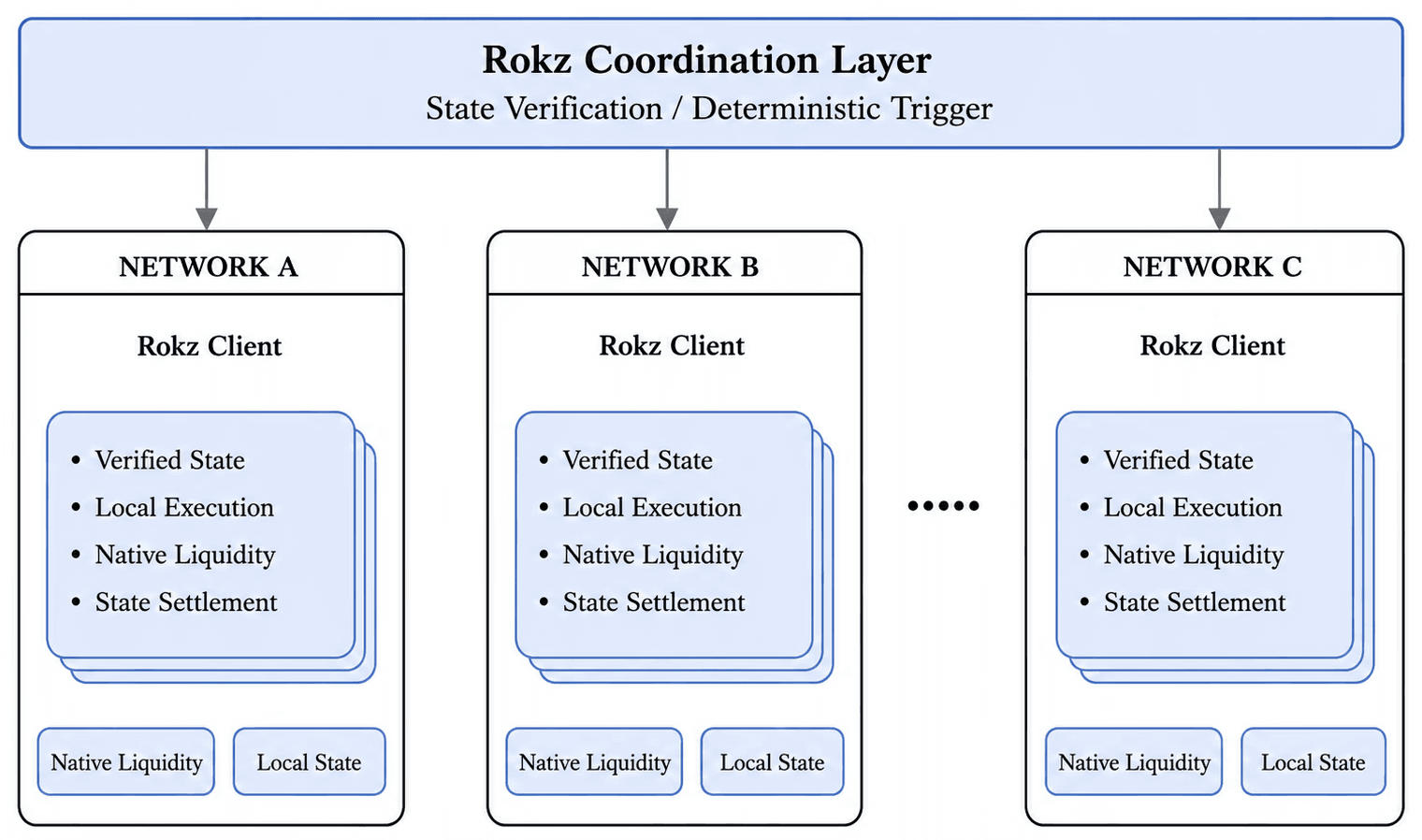
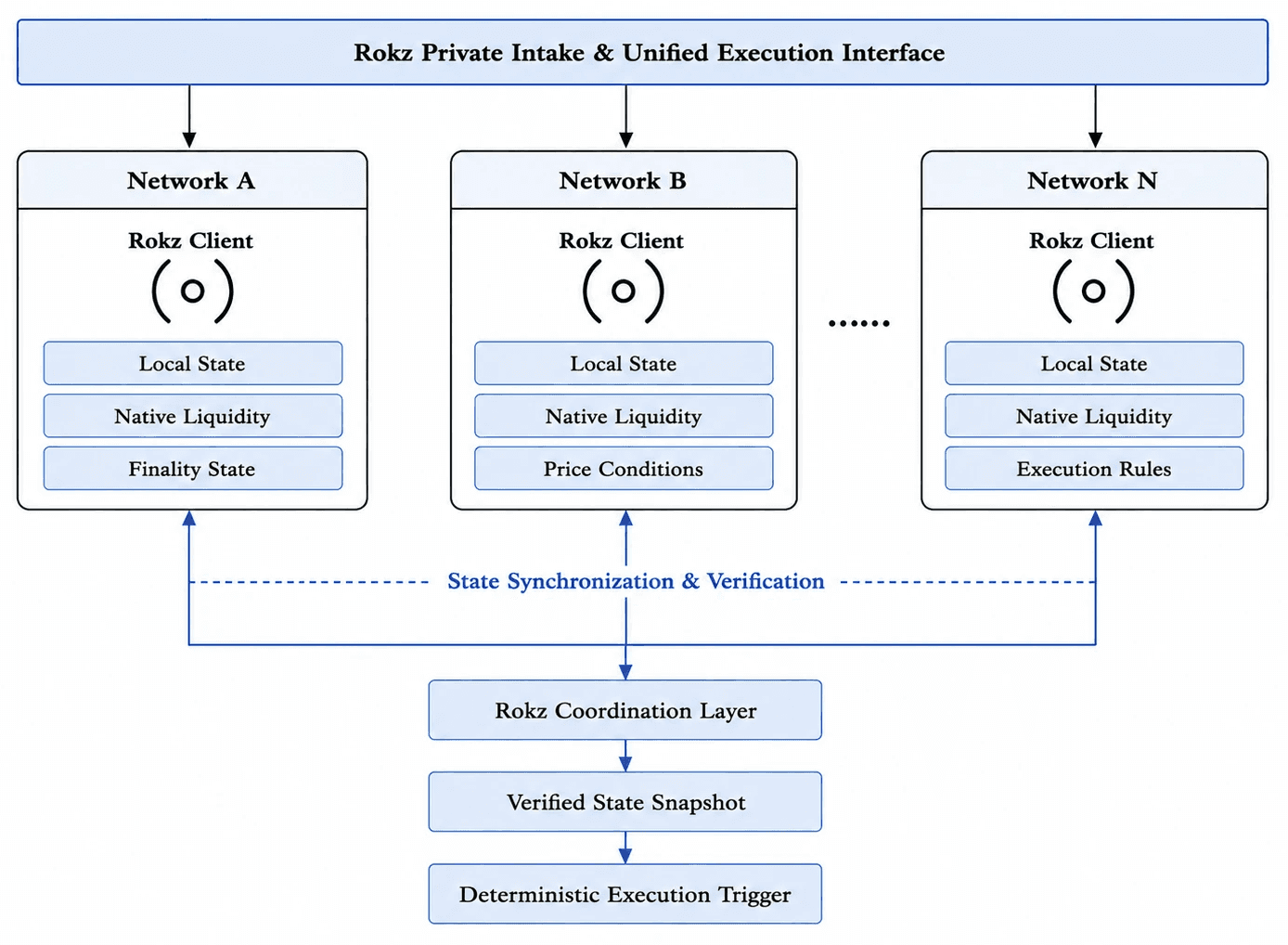
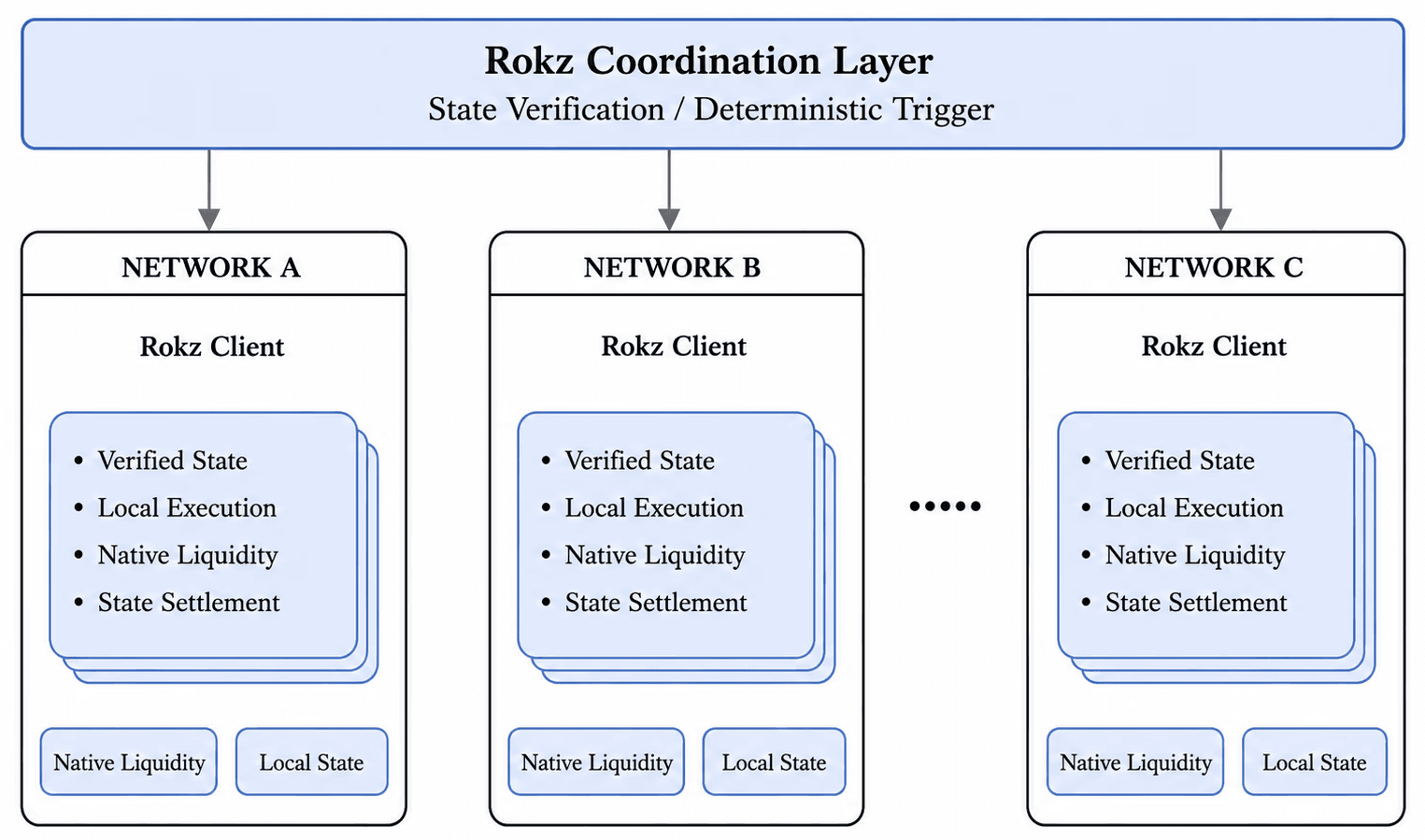
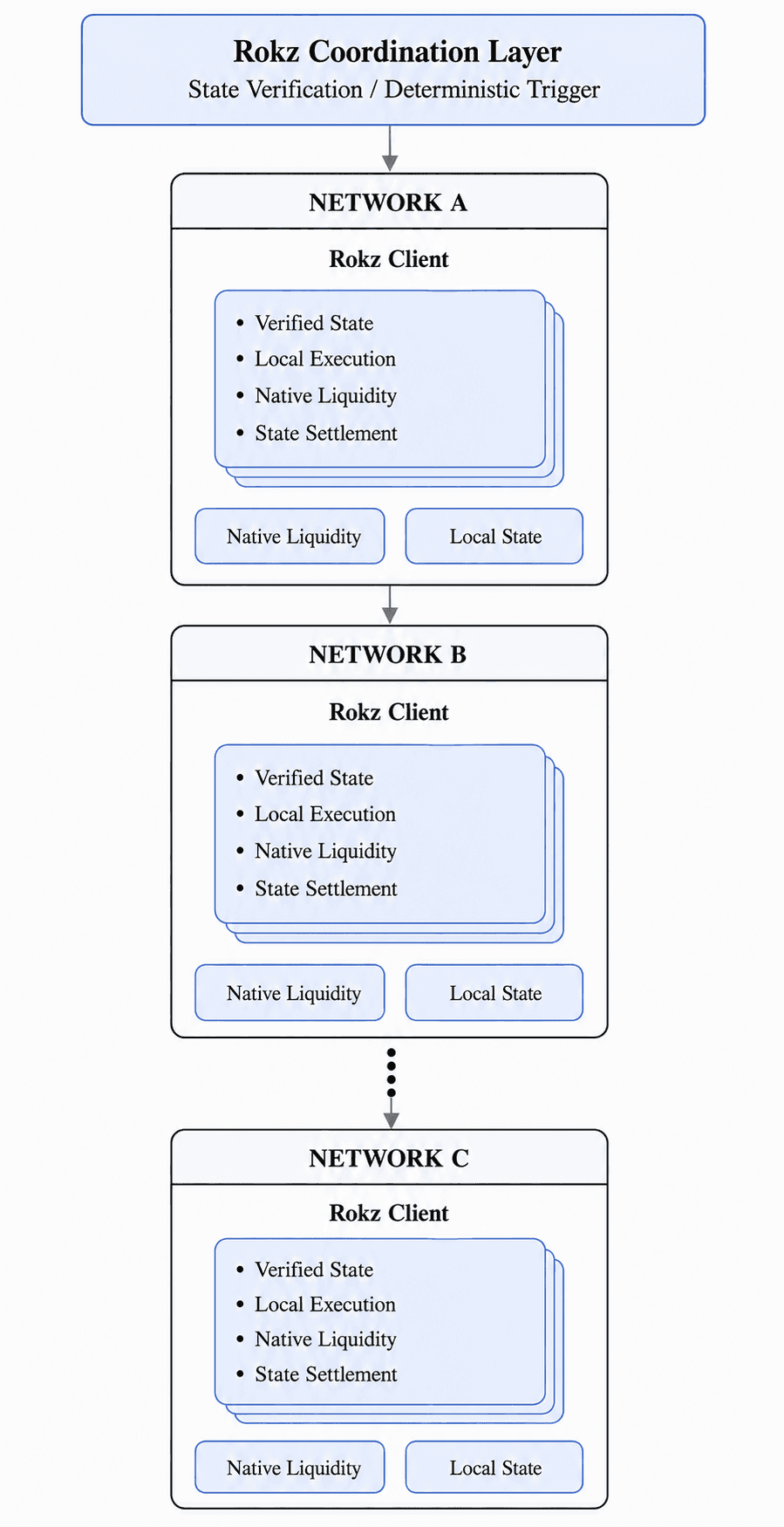
Rokz Clients function as local execution infrastructure inside each supported network. They read blockchain state, verify liquidity, synchronize state, execute transactions locally, and coordinate settlement.

They act as:

local execution engines;

state interfaces;

validation layers;

private execution coordinators;

cross-chain synchronization modules;

universal client interfaces;

native liquidity execution agents.

local execution engines;

state interfaces;

validation layers;

private execution coordinators;

cross-chain synchronization modules;

universal client interfaces;

native liquidity execution agents.

The reason Rokz Clients matter is that deterministic cross-network execution cannot be achieved from a centralized abstraction layer alone. The protocol needs local execution presence inside each network.
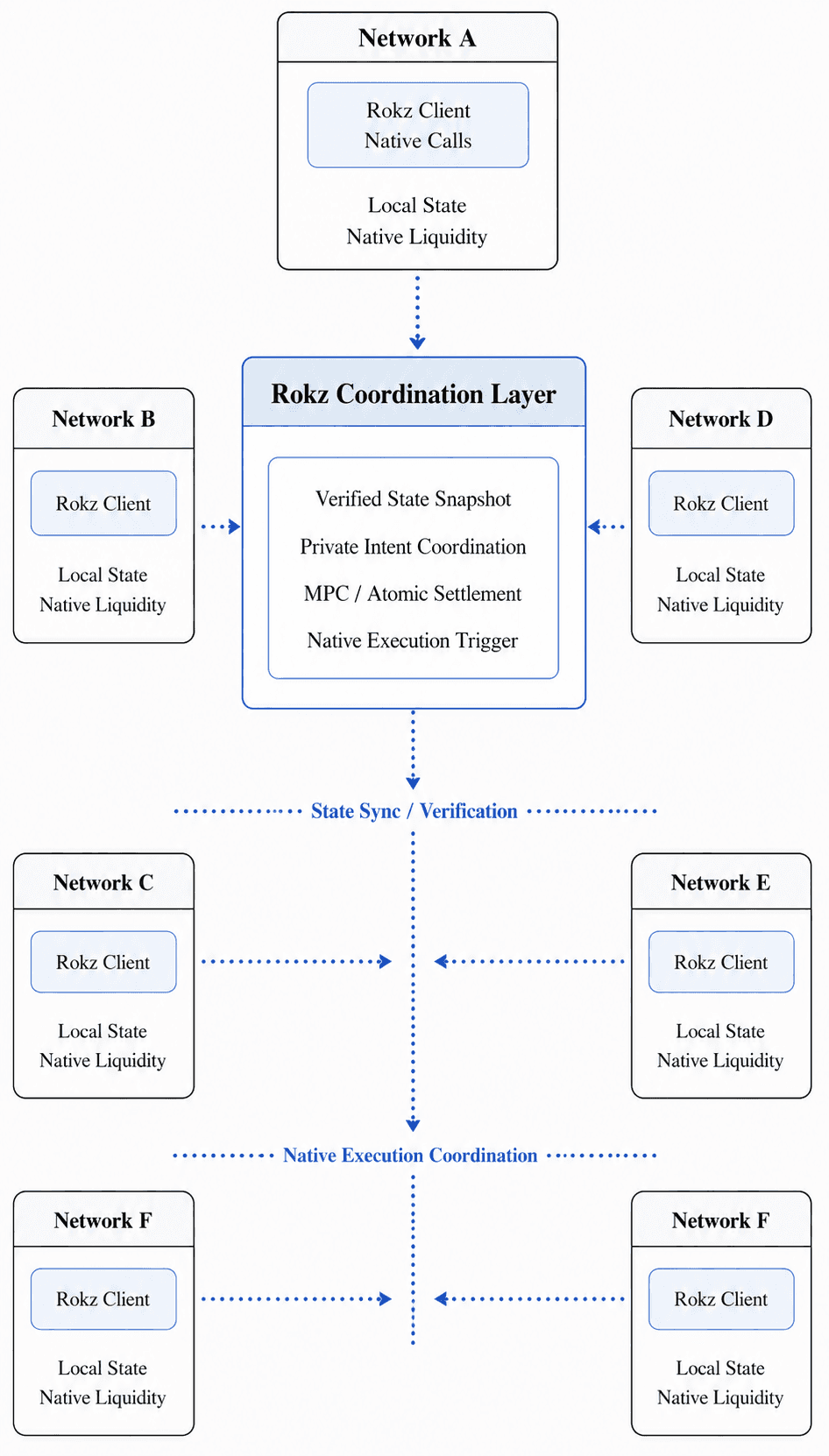
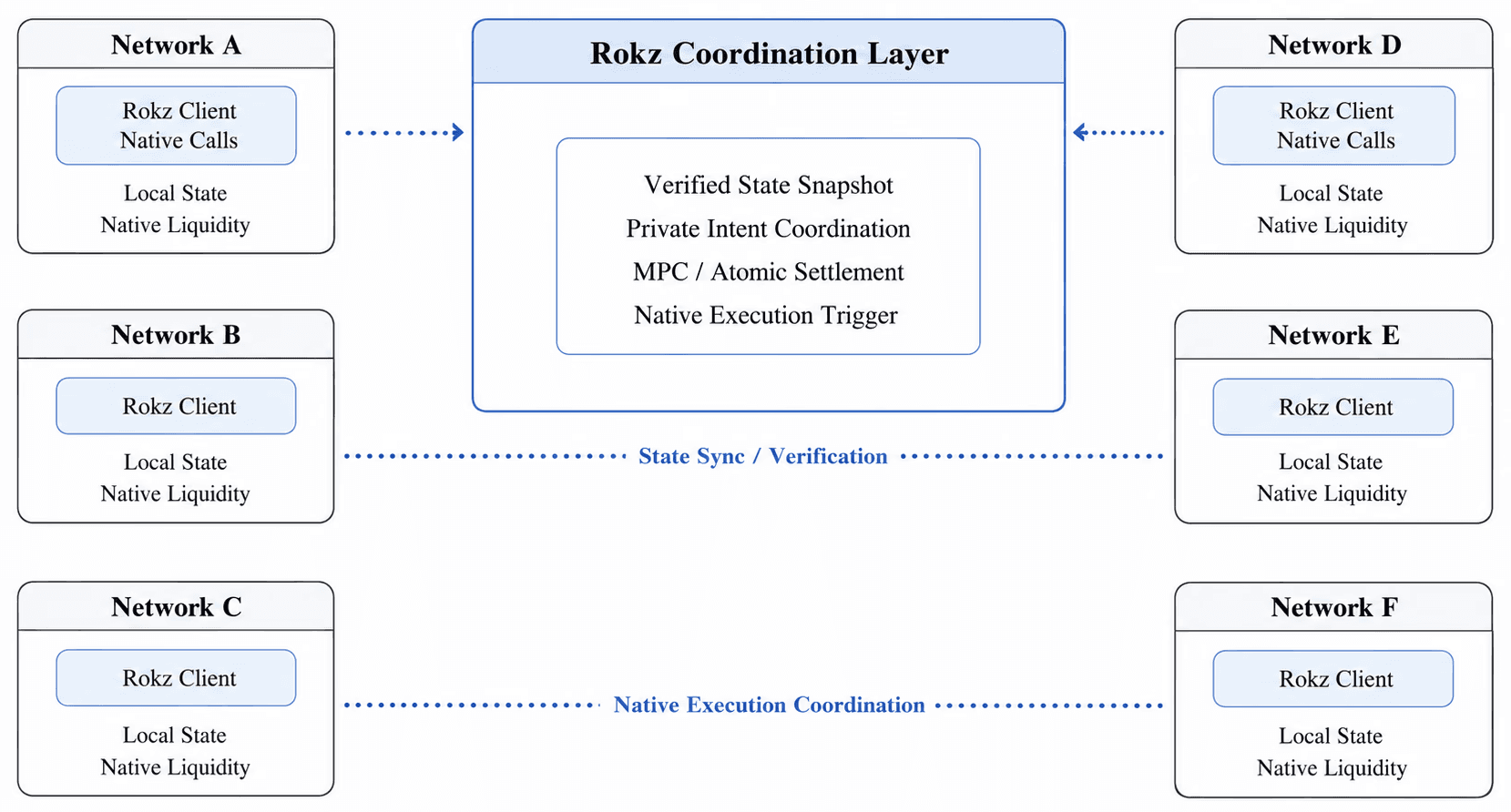
That local presence allows Rokz Clients to:

Local presence allows Clients to:

1.

read state with low latency;

2.

verify liquidity depth;

3.

observe mempool and execution conditions;

4.

submit local smart-contract calls;

5.

coordinate secure signing;

6.

participate in atomic settlement.

1.

read state with low latency;

2.

verify liquidity depth;

3.

observe mempool and execution conditions;

4.

submit local smart-contract calls;

5.

coordinate secure signing;

6.

participate in atomic settlement.

Rokz Clients are not intermediaries. They are the distributed verification and execution infrastructure that makes deterministic cross-network coordination possible.

Rokz Clients are not intermediaries. They are distributed infrastructure enabling deterministic cross-network coordination.

Pie chart showing the distribution of $AUR tokens: 30% for In-Game Purchases (blue), 10% for Governance (pink), 40% for Staking and Rewards (orange), and 20% for Ecosystem Growth (red-orange).
A person seen from the side profile wears a virtual reality (VR) headset in a dark room, illuminated by dramatic blue lighting and a warm glow coming from the headset's lens.

What Rokz Clients Are

Rokz Clients are distributed local execution engines deployed across supported blockchain environments.

They replace the fragmented dependency stack that traditional DeFi applications rely on:

They replace the fragmented dependencies of traditional DeFi:

1.

separate RPC providers;

2.

isolated node infrastructure;

3.

external aggregators;

4.

bridge systems;

5.

relayers;

6.

routing engines;

7.

intermediary execution services.

1.

separate RPC providers;

2.

isolated node infrastructure;

3.

external aggregators;

4.

bridge systems;

5.

relayers;

6.

routing engines;

7.

intermediary execution services.

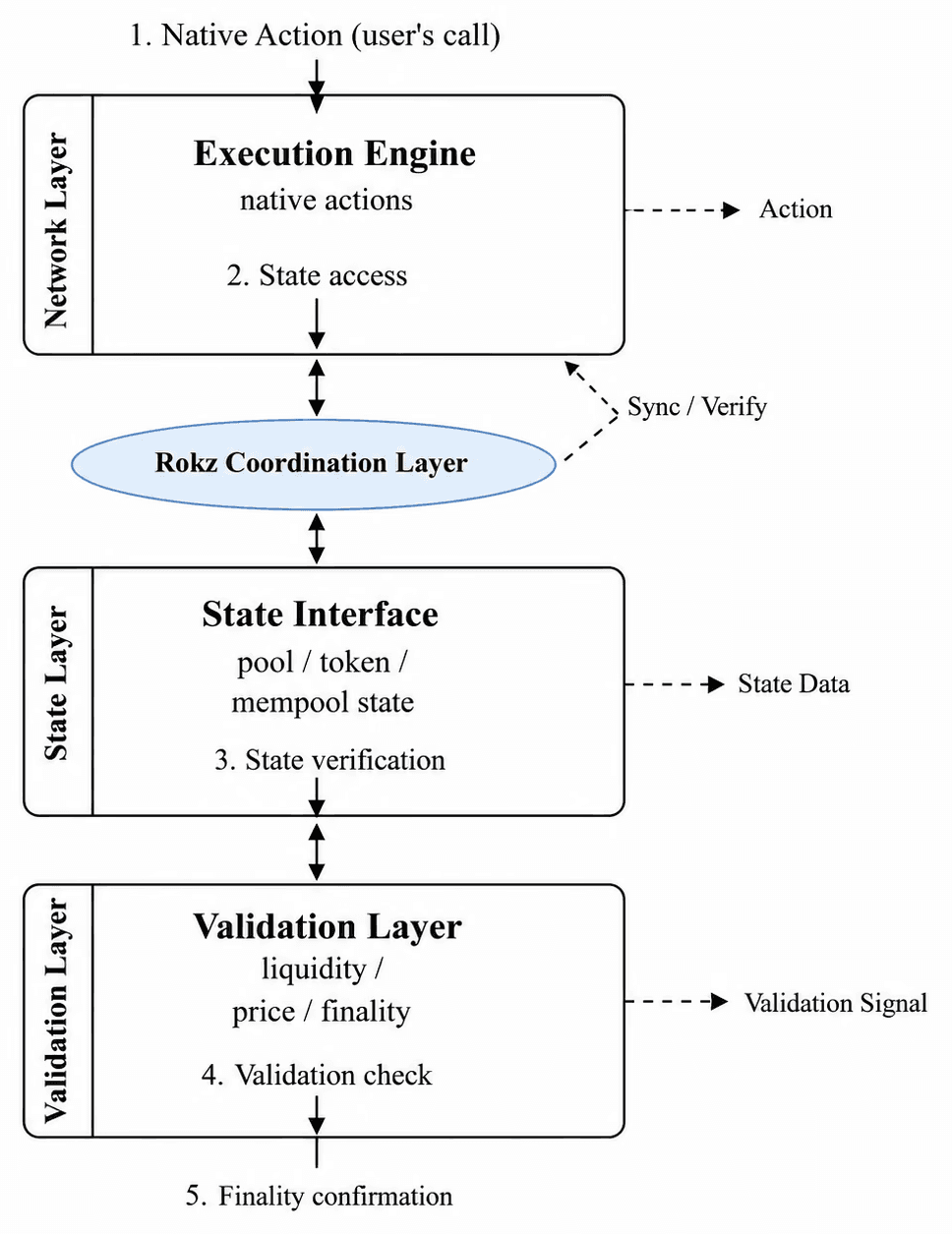
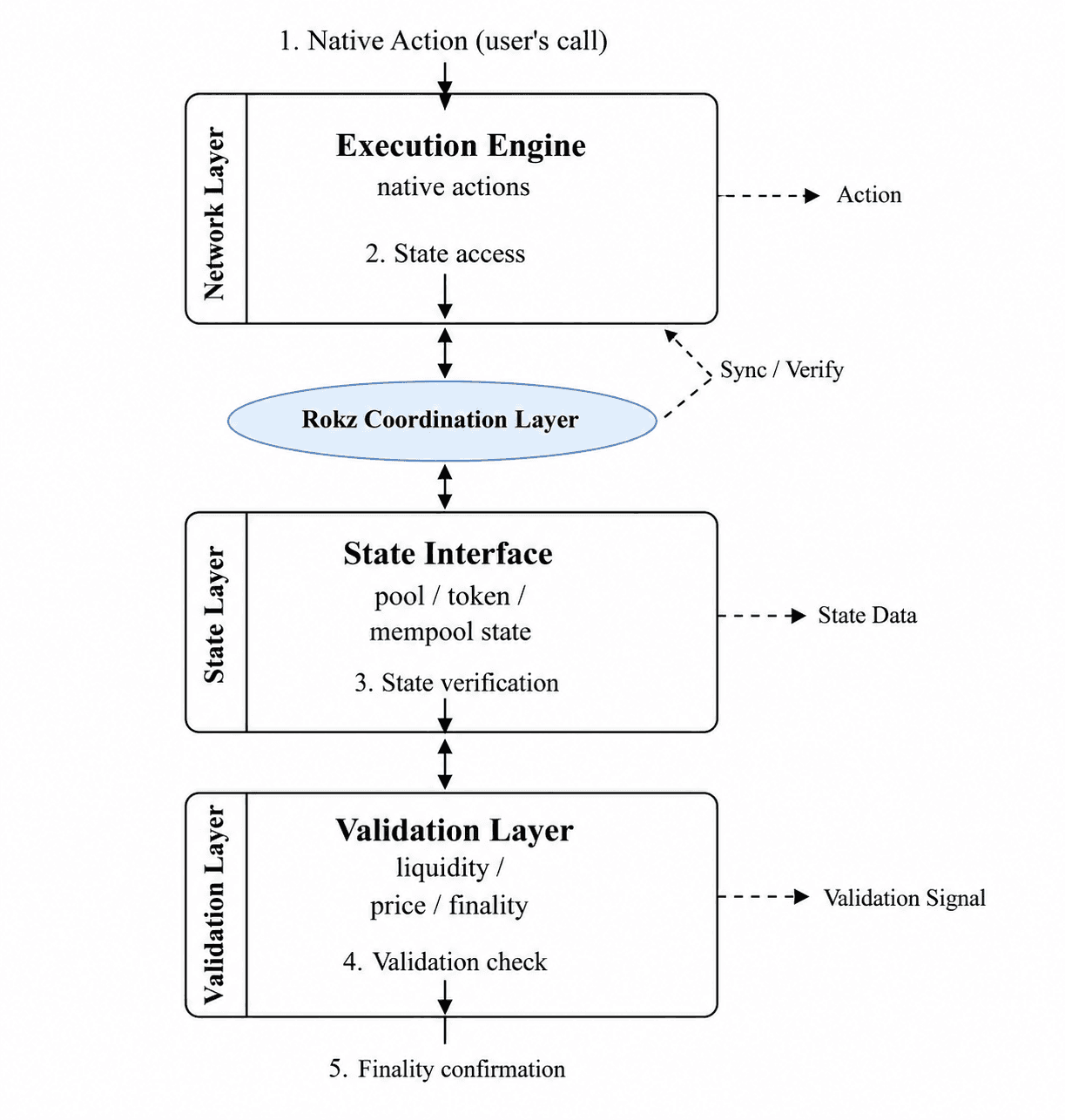
A Rokz Client acts locally inside its network. It retrieves real-time state, checks liquidity depth, validates execution constraints, observes local transaction conditions, interacts with native smart contracts, and coordinates with other Rokz Clients to produce synchronized cross-network execution.

Core Functional Model
⟵ Scroll right/left ⟶

Rokz Client Function

Role and Output

Execution Engine

Calls native actions such as swap, transfer, approve, settle, callback, and related smart-contract operations, producing local native execution.

State Interface

Reads pool state, token availability, transaction conditions, mempool state, and potential slippage conditions, producing real-time local state.

Validation Layer

Verifies liquidity, price conditions, finality assumptions, and coordination readiness, producing execution approval or rejection.

Rokz Client Function

Role and Output

Execution Engine

Calls native actions such as swap, transfer, approve, settle, callback, and related smart-contract operations, producing local native execution.

State Interface

Reads pool state, token availability, transaction conditions, mempool state, and potential slippage conditions, producing real-time local state.

Validation Layer

Verifies liquidity, price conditions, finality assumptions, and coordination readiness, producing execution approval or rejection.

A person seen from the side profile wears a virtual reality (VR) headset in a dark room, illuminated by dramatic blue lighting and a warm glow coming from the headset's lens.
Pie chart showing the distribution of $AUR tokens: 30% for In-Game Purchases (blue), 10% for Governance (pink), 40% for Staking and Rewards (orange), and 20% for Ecosystem Growth (red-orange).

Deterministic execution requires infrastructure inside each network. A protocol cannot verify state, liquidity, execution conditions, and settlement readiness purely from an external routing layer.

Deterministic execution requires infrastructure within each network. State, liquidity, execution conditions, and settlement readiness cannot be verified solely from an external routing layer.

Unified RPC Abstraction

Classical DeFi applications are forced to integrate with many separate RPC environments.

Each blockchain has different:

methods;

data formats;

failure modes;

latency profiles;

transaction submission mechanics;

finality assumptions;

infrastructure maintenance requirements.

methods;

data formats;

failure modes;

latency profiles;

transaction submission mechanics;

finality assumptions;

infrastructure maintenance requirements.

An application operating across Ethereum, Solana, Base, Arbitrum, Sui, BNB Chain, and other environments must maintain separate connections, separate logic, separate error handling, and separate operational assumptions.

This creates duplication, fragility, cost, and integration complexity.

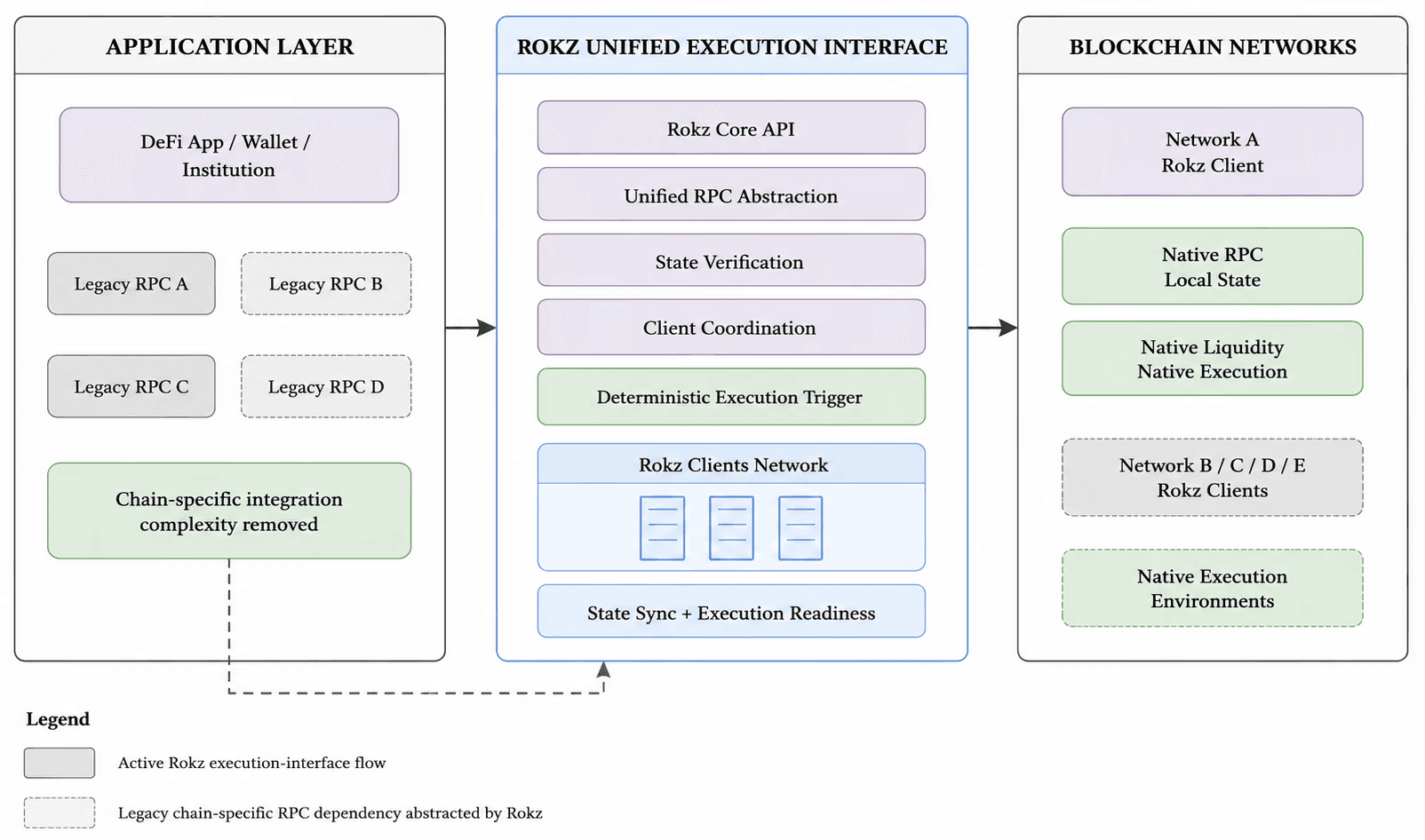
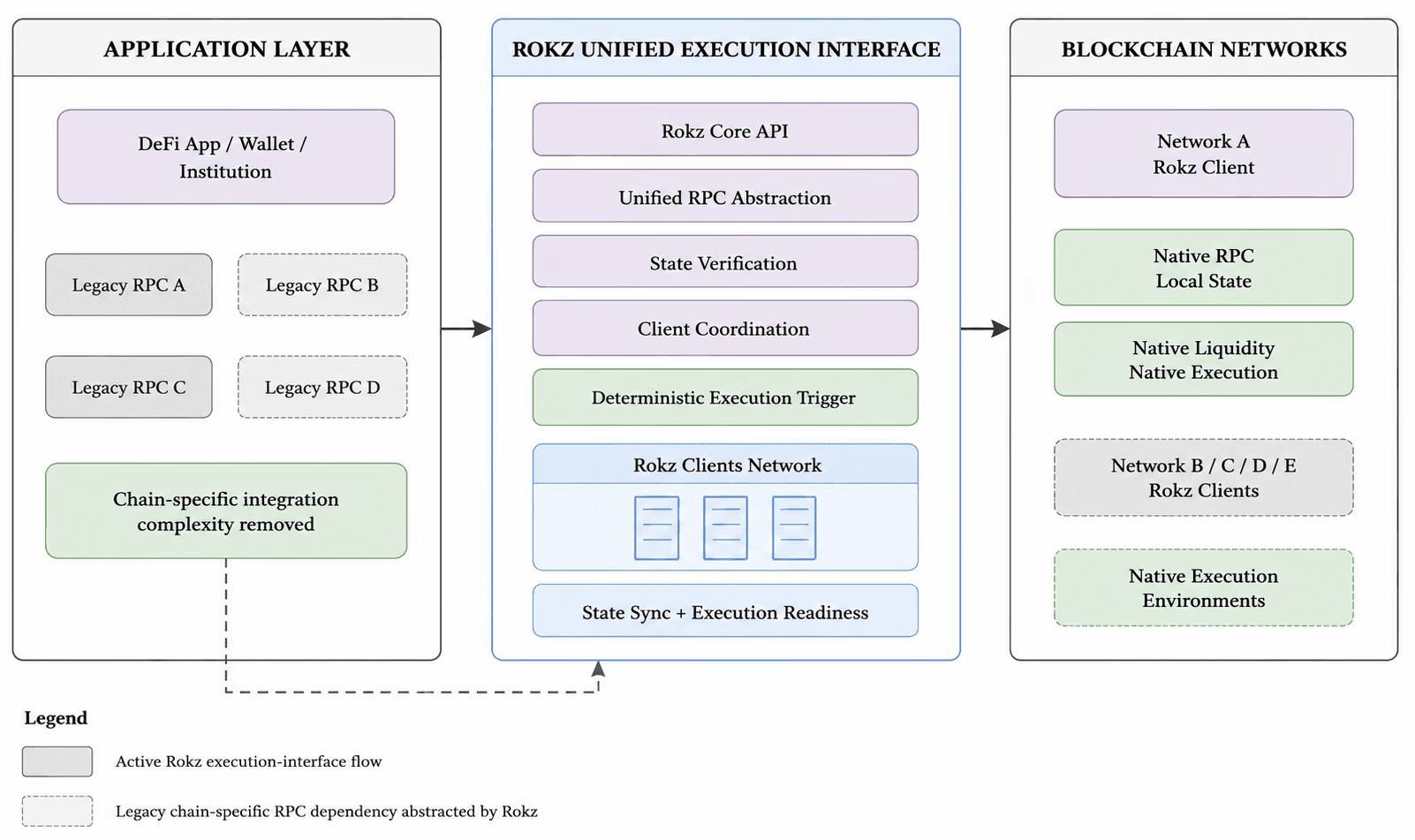
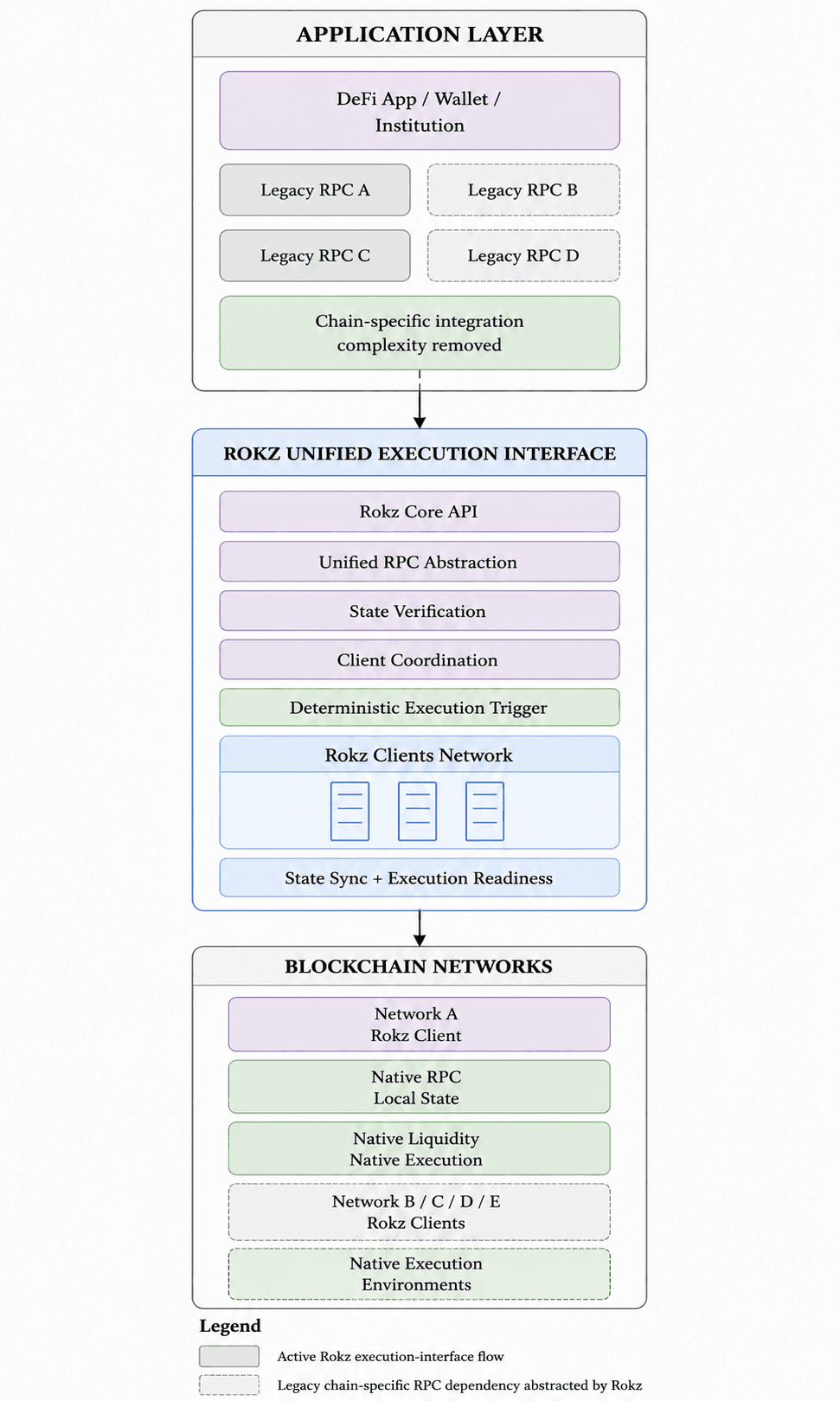
Rokz Clients abstract RPC access into a unified execution interface. Applications interact with Rokz rather than building and maintaining chain-specific integration stacks.

Internally, Rokz Clients:

1.

retrieve state;

2.

verify blocks;

3.

communicate with native contracts;

4.

submit execution;

5.

manage chain-specific complexity;

6.

routing engines;

7.

intermediary execution services.

1.

retrieve state;

2.

verify blocks;

3.

communicate with native contracts;

4.

submit execution;

5.

manage chain-specific complexity.

6.

routing engines;

7.

intermediary execution services.

Before and After Rokz RPC Abstraction

Before vs After Rokz RPC Abstraction

⟵ Scroll right/left ⟶

Traditional Multi-Chain Integration

Rokz Unified Execution Interface

Separate RPC connections per chain

One execution interface

Chain-specific error handling

Rokz Clients manage network complexity

Fragmented infrastructure maintenance

Unified client-based abstraction

Higher operational cost

Reduced integration overhead

Multiple failure points

Consolidated execution infrastructure

Traditional Multi-Chain Integration

Rokz Unified Execution Interface

Separate RPC connections per chain

One execution interface

Chain-specific error handling

Rokz Clients manage network complexity

Fragmented infrastructure maintenance

Unified client-based abstraction

Higher operational cost

Reduced integration overhead

Multiple failure points

Consolidated execution infrastructure

The main thesis is clear:

Applications no longer integrate with every chain. They integrate with one execution interface.
A person seen from the side profile wears a virtual reality (VR) headset in a dark room, illuminated by dramatic blue lighting and a warm glow coming from the headset's lens.
Pie chart showing the distribution of $AUR tokens: 30% for In-Game Purchases (blue), 10% for Governance (pink), 40% for Staking and Rewards (orange), and 20% for Ecosystem Growth (red-orange).
A person seen from the side profile wears a virtual reality (VR) headset in a dark room, illuminated by dramatic blue lighting and a warm glow coming from the headset's lens.

Rokz compresses multi-chain infrastructure into one execution interface, reducing operational overhead for applications, protocols, institutions, and developers.

State Synchronization & Verification

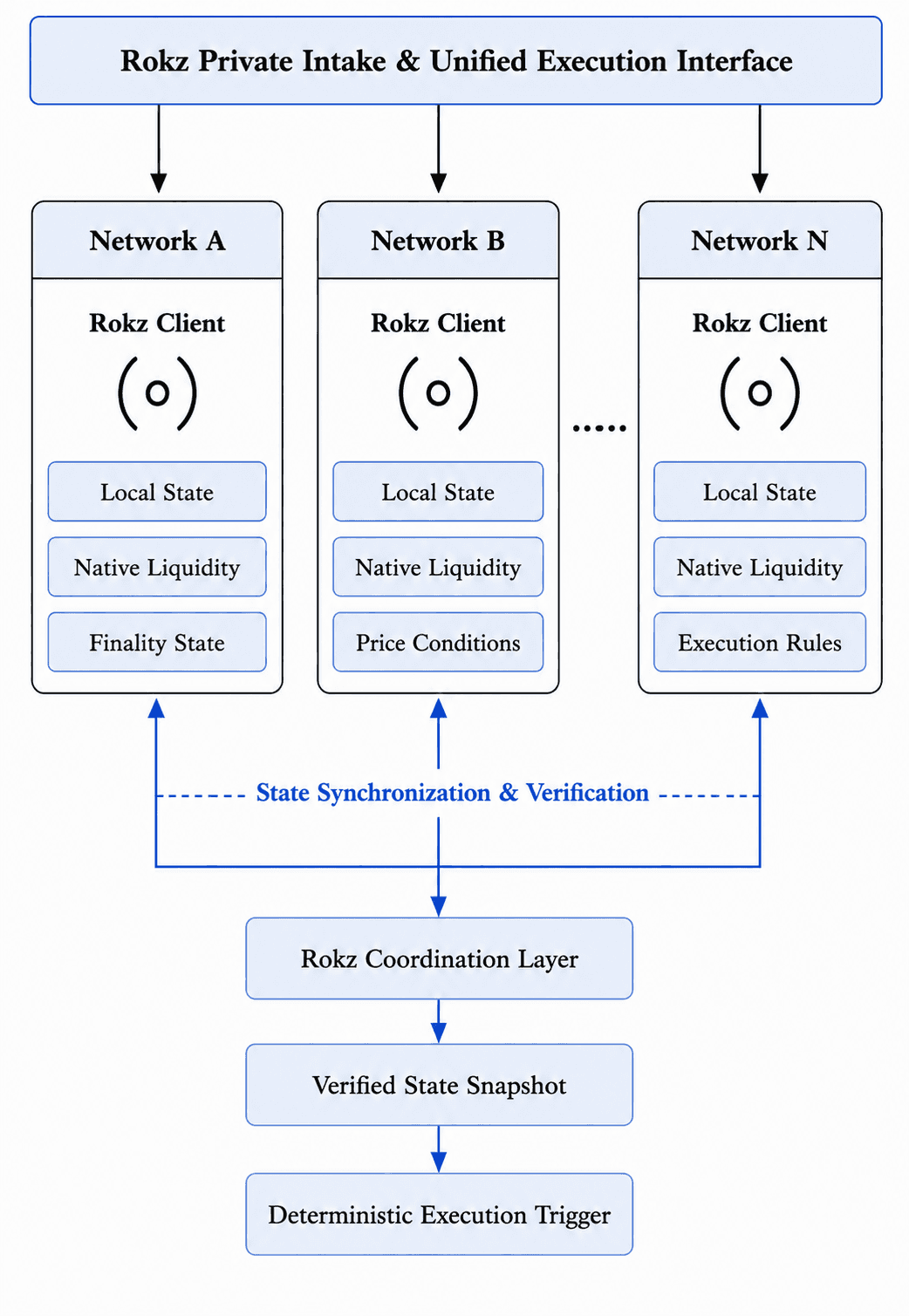
State synchronization and verification are the foundation of deterministic execution.

Rokz Clients retrieve real-time state across chains and verify:

1.

pool liquidity;

2.

token availability;

3.

price conditions;

4.

transaction state;

5.

finality assumptions;

6.

execution constraints;

7.

cross-network coordination readiness.

1.

pool liquidity;

2.

token availability;

3.

price conditions;

4.

transaction state;

5.

finality assumptions;

6.

execution constraints;

7.

cross-network coordination readiness.

Verified states are normalized into a deterministic state snapshot. Execution begins only after state verification is complete. This is how Rokz removes blind transaction submission.
Pie chart showing the distribution of $AUR tokens: 30% for In-Game Purchases (blue), 10% for Governance (pink), 40% for Staking and Rewards (orange), and 20% for Ecosystem Growth (red-orange).

Traditional DeFi systems often execute first and discover failure afterward. A user submits a transaction, the transaction enters a public or semi-public flow, a route is computed, liquidity changes, state drifts, and settlement finalizes probabilistically.

Rokz inverts this sequence.

It verifies state before execution rather than after failure.

State Verification Map

⟵ Scroll right/left ⟶

Verified Object

Why It Matters

Pool liquidity

Confirms sufficient native liquidity before execution

Token availability

Prevents failed or incomplete transaction paths

Price conditions

Reduces quote-to-execution drift

Transaction state

Ensures execution readiness

Finality assumptions

Reduces asynchronous settlement risk

Execution constraints

Prevents invalid or stale execution

Coordination readiness

Confirms cross-network execution viability

Verified Object

Why It Matters

Pool liquidity

Confirms sufficient native liquidity before execution

Token availability

Prevents failed or incomplete transaction paths

Price conditions

Reduces quote-to-execution drift

Transaction state

Ensures execution readiness

Finality assumptions

Reduces asynchronous settlement risk

Execution constraints

Prevents invalid or stale execution

Coordination readiness

Confirms cross-network execution viability

This is the basis for:

1.

near-zero slippage under verified execution conditions;

2.

quote-to-execution integrity;

3.

reduced execution drift;

4.

deterministic settlement;

5.

removal of blind routing assumptions.

1.

near-zero slippage under verified execution conditions;

2.

quote-to-execution integrity;

3.

reduced execution drift;

4.

deterministic settlement;

5.

removal of blind routing assumptions.

When systems execute before state is verified, transaction outcomes depend on changing liquidity, exposed routes, bridge delays, and probabilistic finality. Rokz reverses that sequence.

Rokz removes execution uncertainty by verifying state before execution, not after failure.

Private Execution Infrastructure

Public transaction flow is one of the primary sources of value extraction in DeFi.

When transaction intent enters a public mempool before execution conditions are secured, it becomes visible to adversarial actors. Direction, size, timing, route, and liquidity target can be inferred or directly observed.

That visibility enables:

front-running;

sandwich attacks;

back-running;

route interference;

price-impact attacks;

broader MEV extraction.

front-running;

sandwich attacks;

back-running;

route interference;

price-impact attacks;

broader MEV extraction.

Rokz Clients preserve private transaction flow before execution.

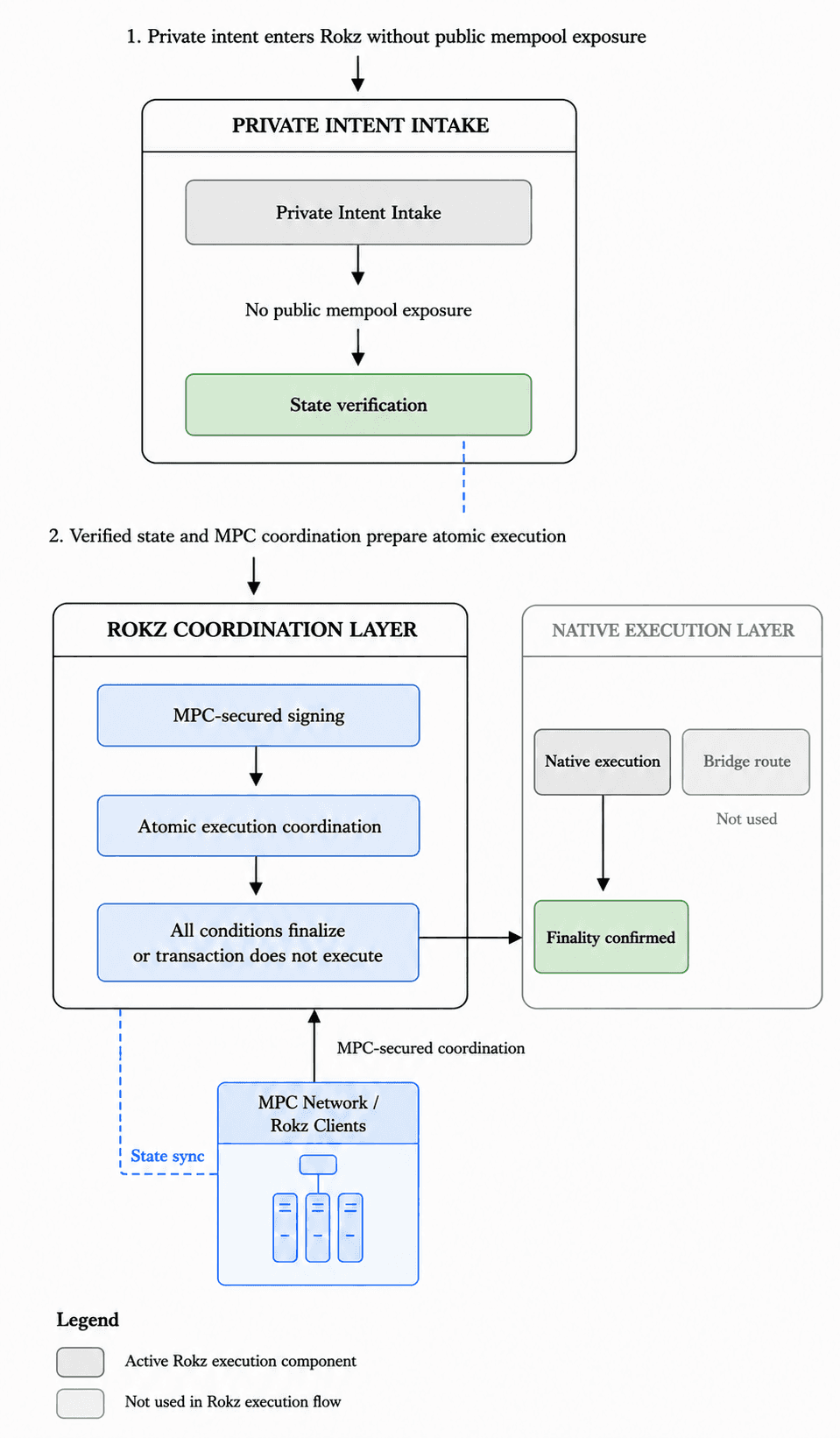
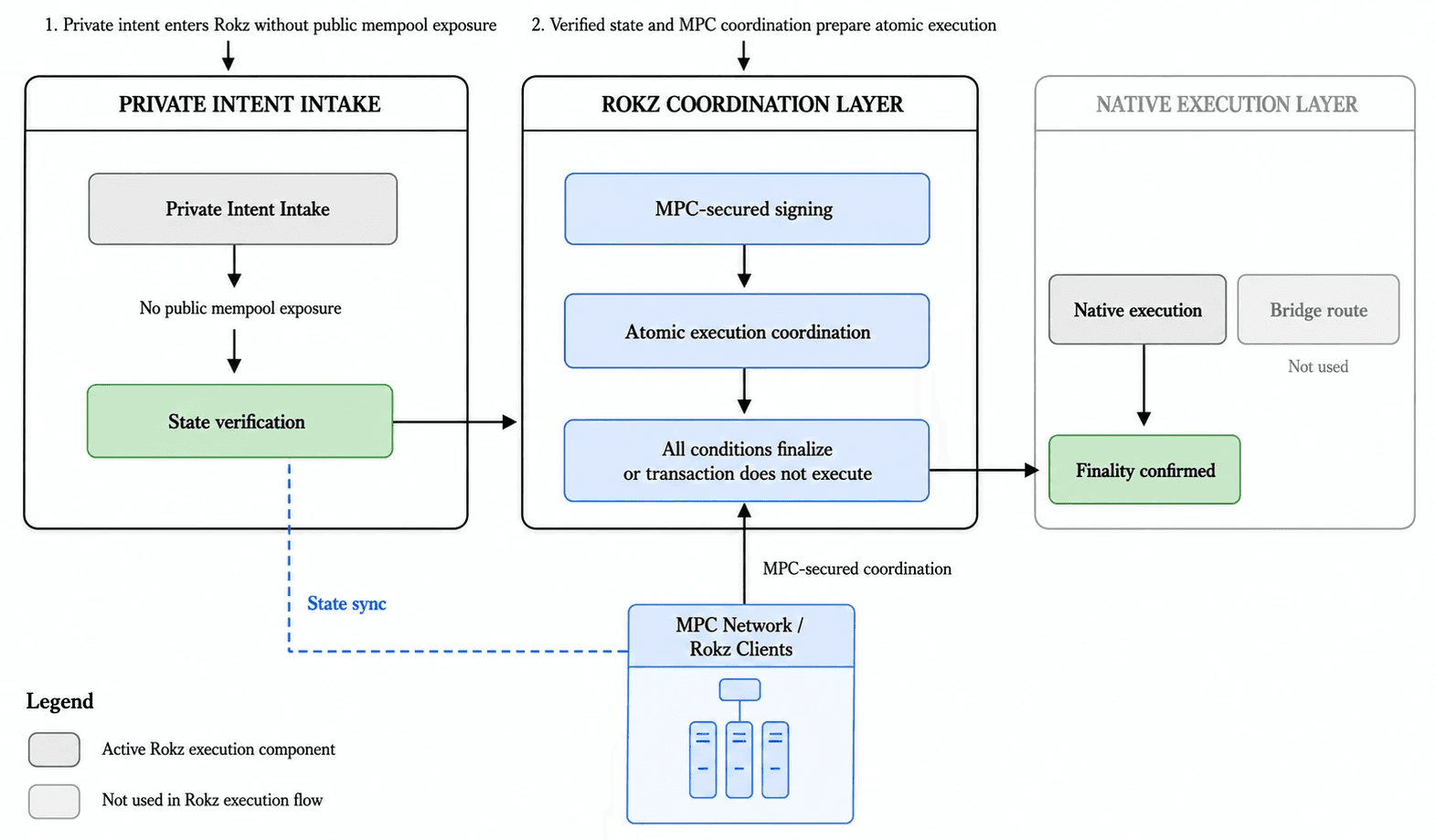
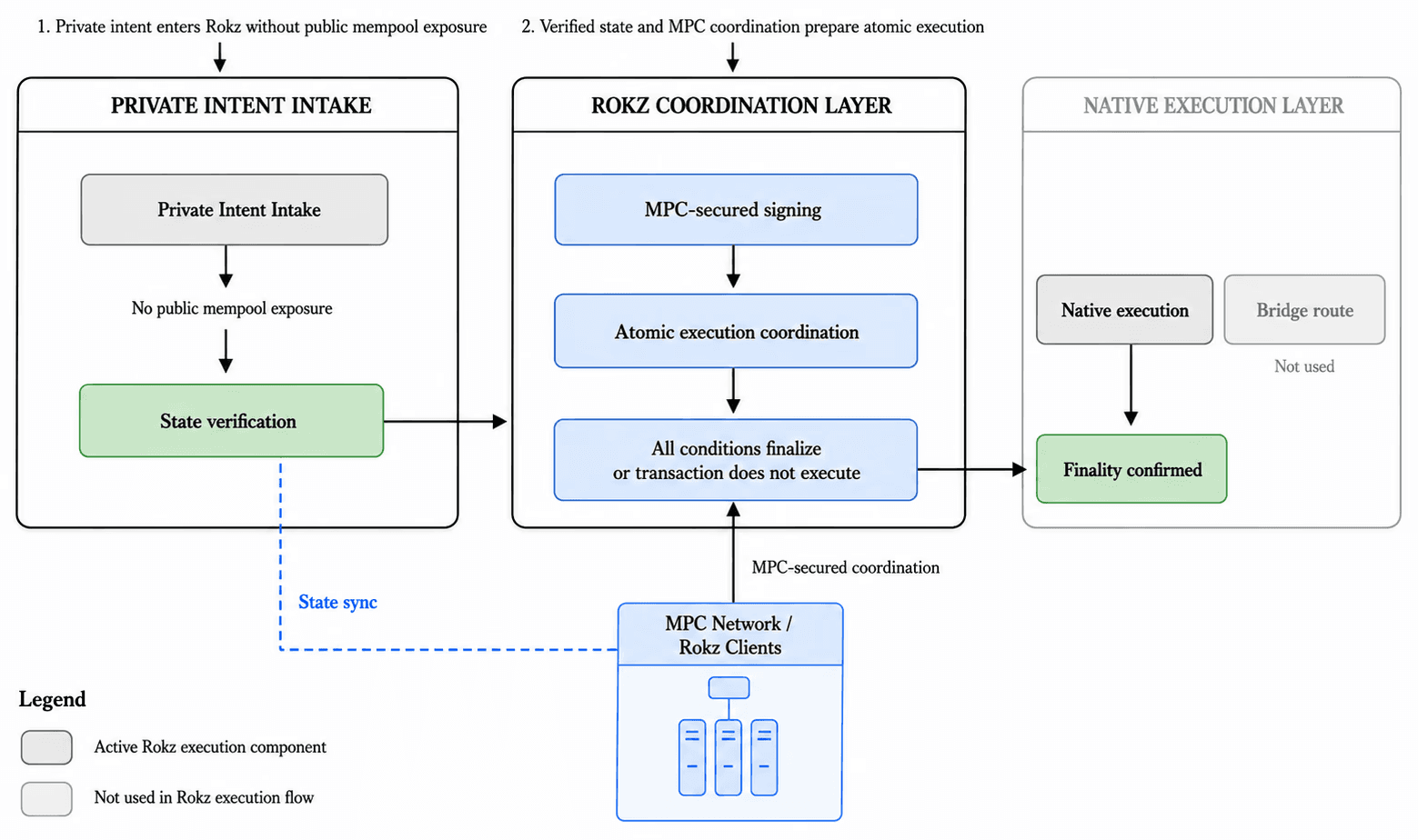
Transaction details, direction, size, and intent are not publicly visible before settlement. Execution is coordinated through private intake and state verification before native transaction triggering occurs.

This removes the visibility layer required for adversarial sequencing.

Private execution is not a privacy feature added on top of Rokz. It is part of the execution architecture required to reduce MEV exposure before transaction conditions are secured.

MEV is not mitigated at the surface. It is structurally addressed by eliminating public pre-execution exposure.

MPC & Atomic Coordination

Rokz uses MPC as part of its secure coordination architecture.

MPC distributes signing responsibility so that:

1.

no complete private key exists in one location;

2.

no single party controls full signing authority;

3.

custody concentration is reduced;

4.

key compromise risk is minimized;

5.

single points of failure are reduced.

1.

no complete private key exists in one location;

2.

no single party controls full signing authority;

3.

custody concentration is reduced;

4.

key compromise risk is minimized;

5.

single points of failure are reduced.

MPC also enables secure cross-network operations and atomic settlement coordination.

In a fragmented transaction environment, signing is not merely an authorization step. It is part of settlement integrity. If execution spans multiple environments, the protocol must ensure that signing, transaction triggering, state confirmation, and settlement finality occur under coordinated conditions.

Atomic coordination means:

1.

all required execution conditions finalize successfully; or

2.

the transaction does not execute.

1.

all required execution conditions finalize successfully; or

2.

the transaction does not execute.

The objective is to prevent partial failure, incomplete cross-network state, or user exposure to broken settlement.
Pie chart showing the distribution of $AUR tokens: 30% for In-Game Purchases (blue), 10% for Governance (pink), 40% for Staking and Rewards (orange), and 20% for Ecosystem Growth (red-orange).

Atomic coordination is not a cosmetic settlement feature. It is the discipline required to prevent users from being exposed to one-sided execution across fragmented networks.
A person seen from the side profile wears a virtual reality (VR) headset in a dark room, illuminated by dramatic blue lighting and a warm glow coming from the headset's lens.

If one side of a cross-network transaction completes while another fails, the user is exposed to broken settlement. Rokz is designed to reduce that risk through MPC-secured coordination and atomic execution logic.

Native Local Execution

Native local execution is one of the most important distinctions in Rokz Protocol.

Rokz does not:

create its own liquidity pool;

custody liquidity;

pull liquidity into a separate protocol layer;

move liquidity across chains before execution;

rely on wrapped liquidity as the core execution model.

Rokz does not:

create its own liquidity pool;

custody liquidity;

pull liquidity into a separate protocol layer;

move liquidity across chains before execution;

rely on wrapped liquidity as the core execution model.

Liquidity remains in native pools where it already exists.
A person seen from the side profile wears a virtual reality (VR) headset in a dark room, illuminated by dramatic blue lighting and a warm glow coming from the headset's lens.
Pie chart showing the distribution of $AUR tokens: 30% for In-Game Purchases (blue), 10% for Governance (pink), 40% for Staking and Rewards (orange), and 20% for Ecosystem Growth (red-orange).

Rokz Clients execute directly inside those environments through local smart-contract calls. If liquidity exists on Ethereum, BNB Chain, Solana, Avalanche, Arbitrum, or another supported network, Rokz coordinates execution inside the relevant native environment rather than transporting liquidity through a bridge or wrapper.

Native Local Execution Thesis

⟵ Scroll right/left ⟶

Layer

Source

Liquidity

Comes from native networks and pools

Execution

Comes from Rokz Clients

Abstraction

Comes from Rokz Protocol

Settlement

Comes from MPC and state-verified coordination

Layer

Source

Liquidity

Comes from native networks and pools

Execution

Comes from Rokz Clients

Abstraction

Comes from Rokz Protocol

Settlement

Comes from MPC and state-verified coordination

This creates the main operational thesis:

Liquidity comes from networks.

Execution comes from Rokz Clients.

Abstraction comes from Rokz Protocol.

Deterministic settlement comes from MPC and state-verified coordination.

Liquidity comes from networks.

Execution comes from Rokz Clients.

Abstraction comes from Rokz Protocol.

Deterministic settlement comes from MPC and state-verified coordination.

Private execution is not a privacy feature added on top of Rokz. It is part of the execution architecture required to reduce MEV exposure before transaction conditions are secured.

Last Modified 1 month ago

Licenses

Last Modified 1 month ago

Licenses

On this page